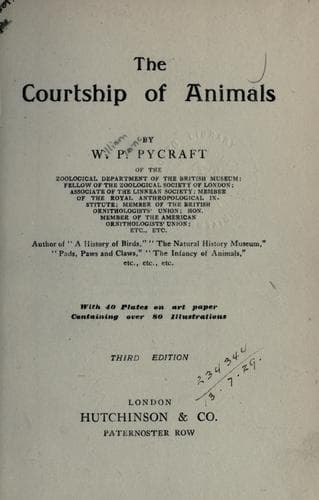
The Courtship of AnimalsPycraft, W. P. (William Plane)
Science
The Courtship of Animals
Pycraft, W. P. (William Plane)
Animal behavior; Natural selection
Germinal Variations—Fishes and mate—hunting—Some remarkable Sexual
differences displayed by the Teeth of Rays—The Double-eyed Fish—The
Coloration of the Dragonet—Some curious facts about Salmon—The strange
use of the kidneys in the Stickle-back—The Stickle-back and parental
duties—Siamese Fighting-fish.
Mammals, Birds, Reptiles and Amphibia, as has already been shown,
all exhibit practically the same line of conduct in regard to their
mate-hunting instincts; all use like modes of expression. And this is a
very significant fact. It becomes more so when we turn to the fishes,
for here again we meet with the same behaviour, and here again we meet
with the same rules in “secondary sexual characters.”
An instance or two of the latter distinction between the sexes should
suffice. As a rule, among fishes, the males are smaller than the
females: commonly there is no other external distinguishing feature
between them. In many cases, however, the males are more or less
strikingly different, thereby showing a departure in the nature of a
higher degree of complexity, or “specialization,” just as obtains among
the birds. And the same sequence to this also obtains. That is to
say, as has already been remarked in the case of the Mammals and the
Birds, the new features first appear in the males, leaving the females
and young of both sexes unmodified. A singular illustration of this is
afforded by some of the Rays, or Skates, as they are often called. In
the Thorn-backed Ray (_Raia clavata_) the teeth of the adult male are
sharp-pointed and directed backwards, while those of the female are
broad and flat, forming a sort of mosaic or pavement. The young male
agrees with the female in this respect. In the Common Blue Skate (_Raia
batis_) the teeth are pointed in both sexes, though more so in the
adult male. In the Spotted Skate (_Raia maculata_) the teeth are fully
pointed in both sexes. Here, then, the normal course in the evolution
of new characters is followed, but it is remarkable that the teeth,
which are so intimately related to the capture of food, should be thus
affected. Whether the change of teeth is associated with a change of
food, or whether neither pointed nor pavement teeth affect the feeding,
is unknown.
Public-domain text, read in full here on John Shaqi.
Reviews
Reviews
No reviews yet
Be the first to share your thoughts on this work.
Elsewhere in the archive
Join the Discussion
Join the discussion
Sign in to leave a comment or review.
Sign InorCreate an account