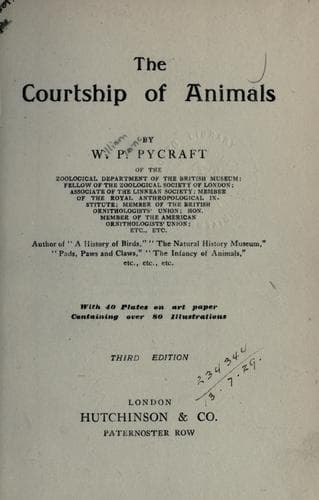
The Courtship of AnimalsPycraft, W. P. (William Plane)
Science
The Courtship of Animals
Pycraft, W. P. (William Plane)
Animal behavior; Natural selection
This search is conducted by the sense of smell. This fact, familiar
enough to-day to the entomologist and the student of Evolution,
was unknown to the earlier naturalists. Neither Darwin nor Wallace
suspected it. It would have been wonderful if they had, for there is
nothing in the general appearance of these insects which suggests an
organ of smell, nor is there anything in the structure of the nervous
system which would indicate this subtle sense. During recent years,
however, the number of workers engaged on the investigation of the
senses of animals has increased immensely, and great strides have been
made in perfecting instruments of research. To the efforts of these
workers we owe the discovery of the seat of the scent-detecting organs
and the source of the scent. The former are furnished by the antennæ,
which lodge also the senses of taste and touch.
Among the Lepidoptera these constitute important secondary sexual
characters, the antennæ, among the Moths at any rate, presenting
striking differences in male and female. The scent-producing organs
are very elusive structures, and so far have been definitely traced,
among Butterflies, only in the males, where they are formed by certain
peculiarly modified scales known as “androconia.” They may be either
irregularly scattered over the wing, or may form complex structures.
Sometimes they are arranged in the form of brightly-coloured,
bristle-like tufts on the hind-wings, sometimes in a fringe along the
edge of the hind-wing. In some of the Moths they are arranged to form
a thick, glistening white felt, which fills a folded-over portion
of the edge of the hind-wing, and in many cases “the perfume can be
retained,” Weismann remarks, “and then, by a sudden turning out of the
wing-fold, be allowed to stream forth.” In the Ghost-moth (_Hepialus
humuli_), the hind-legs of the male have become pressed into service
and have become transformed into scent-bottles, since they are swollen
and filled with glands for the manufacture of odorous matter.
The naturalist Fritz Müller discovered the fact that some of the
Butterflies which haunted his Brazilian garden exhaled a flower-like
fragrance. Anyone can test this curious trait for himself who will take
the trouble to brush his finger over the wing of a newly-caught male
Garden-White Butterfly (_Pieris napi_). The white powder which will
adhere to the finger will be found to be made up of the wing-scales,
which will exhale a delicate perfume of lemon or balsam! Among the
Moths the strong odour of musk is exhaled by the Convolvulus Hawk-moth
(_Sphinx convolvuli_).
Public-domain text, read in full here on John Shaqi.
Reviews
Reviews
No reviews yet
Be the first to share your thoughts on this work.
Elsewhere in the archive
Join the Discussion
Join the discussion
Sign in to leave a comment or review.
Sign InorCreate an account