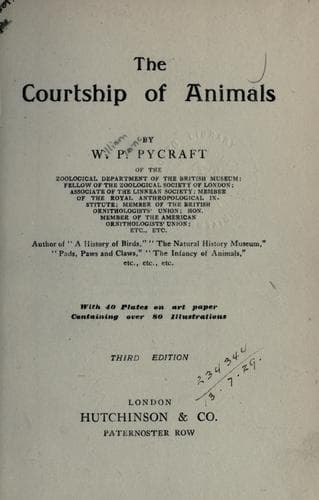
The Courtship of AnimalsPycraft, W. P. (William Plane)
Science
The Courtship of Animals
Pycraft, W. P. (William Plane)
Animal behavior; Natural selection
The existence, then, of bright colours in this and other species
in like case, seems to show that it has nothing to do with Sexual
Selection, directly at any rate. The males having assembled, their
presence is probably communicated to the female by the characteristic
male odour, which is never of the same penetrating quality as that
of the female. There is no need that it should possess this, for the
females never seek their mates. The successful male, where several
rivals are competing, is probably not simply the strongest, but he
who also disperses the right odour necessary to provoke the pairing
response. These illustrations furnished by the scent-hunting,
scent-dispersing males and females are of the highest importance
to students of the Sexual Selection theory, for they seem to show
conclusively that coloration plays at any rate but a minor part
therein. The importance of the scent-detecting organs is shown in
the very different types of antennæ which obtain between male and
female Moths, those of the male taking the form of huge feather-like
structures, as in some Saturniidæ, and far exceeding those of the
female in size.
The methods of pairing which obtain among Butterflies and Moths, it is
not surprising to find, are very different; for whereas in the former
it takes place on the wing, in the latter the female is always in a
resting position. Where the females are winged, long flights are often
taken for the purpose of depositing and distributing the eggs: the
flightless forms make no such excursions. A few, as in the case of some
of the _Psychidæ_ are not only wingless, but limbless and maggot-like.
They never leave the chrysalis case, but deposit their eggs inside it.
Though there is undoubtedly much that is wonderful about the mating
of these scent-distributing species, the history of the Moths of the
genus Acentrophus is more wonderful and more mysterious still. For
the females are aquatic. The males may sometimes be found in crowds
fluttering over the surface of large but shallow sheets of water. The
females, which are wingless, come to the surface and, like sirens, draw
the males under water, where coupling takes place; after which they
probably immediately die. But how do they discover their submerged
mates? The escape from the water of any odour which the females may
possess seems well nigh impossible.
Public-domain text, read in full here on John Shaqi.
Reviews
Reviews
No reviews yet
Be the first to share your thoughts on this work.
Elsewhere in the archive
Join the Discussion
Join the discussion
Sign in to leave a comment or review.
Sign InorCreate an account