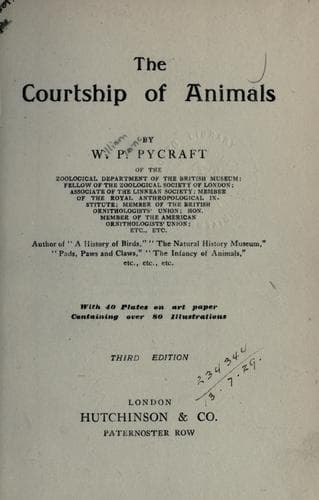
The Courtship of AnimalsPycraft, W. P. (William Plane)
Science
The Courtship of Animals
Pycraft, W. P. (William Plane)
Animal behavior; Natural selection
In relation to the Sexual Selection theory these excrescences are
of quite exceptional interest, for they throw a strong light on the
meaning of ornament, such as obtains among birds, which seem to show a
consciousness of its existence and effectiveness. Darwin argued from
the birds to the Beetles. Convinced that the gorgeous crests and trains
and vivid colours were appreciated by the females of the former, he was
impelled to believe that the ornaments of the latter had developed in
like case by the fostering influences of the females. Similarly, from
the evidence as to the use of horns in the case of mammals, and spurs
in the case of birds, he was induced to believe that the horn-like
outgrowths of Beetles had been attained by like influences. But in
both kinds of cases, he could only infer their action, for he could
discover no really decisive instances of conquest either by display or
by battle, such as he was able to produce in the case of the higher
animals. Had chance directed his attention in the beginning either
to the Warblers among the birds, or the beetles among the insects,
his interpretation of the action of sexual selection, it is more than
probable, would have been materially different from that developed in
the “Descent of Man.” No additions of any importance have been added to
the facts he so laboriously collected.
As touching the “horns” it should be remarked that these may arise
either from the head or from the thorax, or from both, and sometimes
even from the under surface of the body.
One of the most remarkable instances of these singular outgrowths is
that of the Hercules Beetle (_Dynastes hercules_) of the West Indies
and tropical America. Herein the roof of the head is prolonged into
a great upturned beam bearing tooth-like prominences, and the top
of this is opposed to a still more massive beam, whose base covers
the whole roof of the thorax, and whose tip extends far beyond that
projecting from the head. A pair of “teeth” point downwards from the
middle of this beam, whose under surface is thickly covered with short
chestnut-coloured hairs forming a brush-like surface. In another,
_Copris isidis_, the head bears two short, rhinoceros-like horns,
and the thorax a short, triangular overhanging ledge: in _Phanœus
jaunus_ there is a single horn on the head, and the thorax bears
two short, forwardly-projecting blades, one on each side; while in
_Onthophagus rangifer_—the Reindeer Beetle—the head bears a pair of
horns curiously like the antlers of a deer. One might cite many such
instances, all varying in detail, but these will suffice.
Public-domain text, read in full here on John Shaqi.
Reviews
Reviews
No reviews yet
Be the first to share your thoughts on this work.
Elsewhere in the archive
Join the Discussion
Join the discussion
Sign in to leave a comment or review.
Sign InorCreate an account