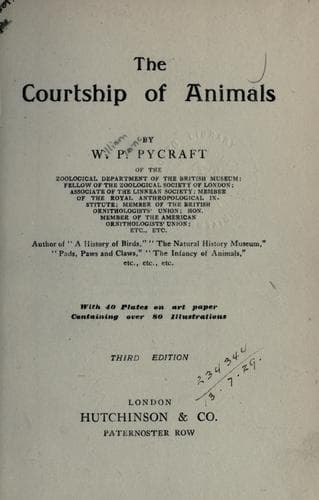
The Courtship of AnimalsPycraft, W. P. (William Plane)
Science
The Courtship of Animals
Pycraft, W. P. (William Plane)
Animal behavior; Natural selection
While it is difficult to picture the initial stages of growth of so
complex an organ as that of the Cicada, the beginnings of simpler
structures such as the stridulating organs of Beetles and Grasshoppers
are more easily discernible. “It is probable,” remarks Darwin, “that
the two sexes of many kinds of Beetles were at first enabled to find
each other by the slight shuffling noise produced by the rubbing
together of the adjoining hard parts of their bodies; and that as
those males or females which made the greatest noise succeeded best
in finding partners, rugosities on various parts of their bodies were
gradually developed by means of sexual selection into true stridulating
organs.”
Structures to which we can ascribe a use are commonly supposed to have
been evolved for the purpose which we assign to them. The “horns”
of Beetles afford a case in point; but there are many other equally
remarkable and extravagant developments among the insects which seem to
defy explanation. And they will continue to do so until it is realized
that they are but exaggerations of the normal processes of growth,
which is not limited to definite areas but may produce extensions
and excrescences of an almost infinitely varied character. The only
controlling factor is that imposed by Natural Selection when these
growth-changes tend to impair the well-being of the organism as a
whole. Often such changes confer benefits, giving rise to new organs,
and in this case Natural Selection encourages the new departure.
Nothing, indeed, “succeeds like success.” New departures in one
direction may be promptly suppressed, in another they spell fortune:
there is no “Socialism” in Nature. Often these “new departures” neither
help nor hinder, and instances of this kind are commonly afforded
by “ornaments.” One of the most singular illustrations of this kind
is furnished by that extraordinary Long-horned Grasshopper of India
(_Schizodactylus monstrosus_), wherein the wings, when at rest, have
their tips coiled up like a watch-spring, while the appendages to the
legs are scarcely less remarkable. It is a burrower, driving long
tunnels in the banks of rivers. But little is known of its habits,
save that it does not emerge from its burrow till night, when it takes
long flights. This being so, the bizarre character of its wings and
legs is the more difficult to explain on any Sexual Selection theory.
But regarded as spontaneous variations which have not fallen under the
ban of Natural Selection, they are somewhat less puzzling, though,
having regard to the extraordinary transformation which the burrowing
Mole-cricket and the allied Cylindrodes have undergone, in adaptation
to fossorial habits, the legs of this insect are remarkable indeed.
Public-domain text, read in full here on John Shaqi.
Reviews
Reviews
No reviews yet
Be the first to share your thoughts on this work.
Elsewhere in the archive
Join the Discussion
Join the discussion
Sign in to leave a comment or review.
Sign InorCreate an account