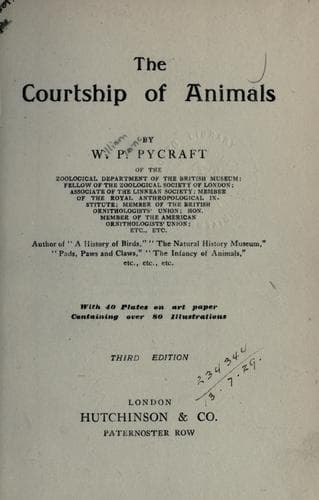
The Courtship of AnimalsPycraft, W. P. (William Plane)
Science
The Courtship of Animals
Pycraft, W. P. (William Plane)
Animal behavior; Natural selection
“In order to understand the matter it should be known that these
crabs ... are gregarious, and that each one has a burrow of its own.
Though they may be seen marching in battalions across the sand, yet as
a rule they stay close to their burrows, methodically searching and
sifting the surrounding sand for any food that may have been thrown
up by the tide, and flying to their burrows with headlong speed when
alarmed. At first sight one does not understand the necessity for so
much wariness, and for such a deep system of entrenchment, for the
creatures seem to hold undisputed possession of the whole shore; but as
a matter of fact they are preyed upon all day long by Brahminy kites,
and when the jackals come out in the evening, by them. Now, although
each crab may on ordinary peaceful occasions know its own home, yet
when a crowd of them are running for their lives they may sometimes,
one would think, act on the devil take the hindmost principle and
try to squeeze into the nearest burrow. But as ancient philosophers
do report, things may be done upon occasion which it is inexpedient
to make a habit of doing, and this seems to be one of those things;
for if many Crabs made a practice of crowding into one small burrow
they would certainly run the risk of being suffocated, if not crushed
to death outright. It seems probable, therefore, that it would be
advantageous to the species as a whole if the rights of property in
burrows were rigidly respected, and if each individual member possessed
some means of giving notice that its burrow was occupied ... and
I think that this consideration gives us a clue to the use of the
stridulating mechanism. At any rate, I was often able, after my first
accidental discovery, to elicit the sound, by catching one of these
crabs and forcing it into a burrow which I knew was already occupied:
the intruder would never go far in, but would crouch just inside the
mouth of the burrow, and if it were made to travel deeper, then the
voice of the rightful owner would be heard in indignant remonstrance
from the depths.” Another species, the Grey Ocypode Crab (_Ocypoda
ceratophthalmus_), possesses a similar instrument, and makes therewith
a loud, croaking noise. But it does not often burrow deeply. Colonel
Alcock therefore suggests that in this case it may be used for scaring
enemies.
That these curious musical instruments may also be used in mate-hunting
seems highly probable. If the stridulation is produced on one occasion
to announce the fact that callers are not desired, it may on another
signify an equally emphatic invitation to enter, the mood of the
occupant being expressed by the character of the sounds emitted. It is
significant, at any rate, that there are no external sexual differences
in these species; hence the probability that it is by stridulation that
the sexes distinguish one another.
Public-domain text, read in full here on John Shaqi.
Reviews
Reviews
No reviews yet
Be the first to share your thoughts on this work.
Elsewhere in the archive
Join the Discussion
Join the discussion
Sign in to leave a comment or review.
Sign InorCreate an account