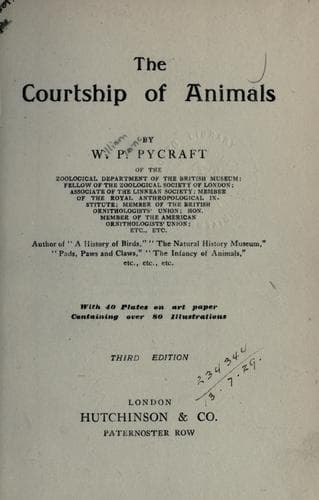
The Courtship of AnimalsPycraft, W. P. (William Plane)
Science
The Courtship of Animals
Pycraft, W. P. (William Plane)
Animal behavior; Natural selection
“If we inquire into the manner of the origin of secondary sexual
characters of this kind, we shall find that both may have been
increased by sexual selection, for a male with a better sickle will
succeed more quickly in getting into the proper position for copulation
than one with a less perfect mechanism. This assumption does not rest
on mere theory, for I was once able ... to observe for a considerable
time, under the microscope, a female to whose shell two males were
clinging, each trying to push the other off. Nevertheless, it seems
to me very questionable whether the origin of this sickle-claw
can be referred to sexual selection, for without this clamping-organ
copulation in most Daphnids would not be possible. It was thus not as
an advantage which one male had over another that the clamping-sickle
evolved, but rather as a necessary acquisition of the whole family,
which must have developed in all the species at the same time as the
other peculiarities, and notably those of the shell. The competition of
the males among themselves is thus in this case simply an expression
of the struggle for existence on the part of the species as such, and
it is not a question merely of a character which makes it easier for
the males to gain possession of the females, but of one which had
necessarily to arise lest the species should become extinct. In other
words, in this case Natural Selection and Sexual Selection coincide.
“The case of the antennæ of _Moina_, which have been modified into
grasping organs is quite different; these owe their origin, not to
natural selection, but to sexual selection, for antennæ of that kind
are not indispensable to the existence of the species, as we can see
from the closely related genera, Daphnia and Simocephalus, where the
males have quite short, stump-like antennæ, furnished with olfactory
filaments not much more numerous than the females possess. Just as
these supernumerary olfactory filaments were produced by sexual
selection and not by the ordinary natural selection, because those
males with the more acute sense of smell had an advantage over those in
which it was blunted, so the males of the genus Moina which could grasp
most securely had an advantage over those that gripped less firmly, and
thus arose these two different kinds of male characteristics. Neither
of them is of advantage to the species as such, but only to the males
in their competition for the possession of the females.”
Public-domain text, read in full here on John Shaqi.
Reviews
Reviews
No reviews yet
Be the first to share your thoughts on this work.
Elsewhere in the archive
Join the Discussion
Join the discussion
Sign in to leave a comment or review.
Sign InorCreate an account