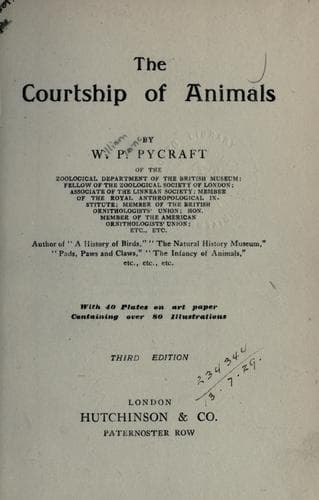
The Courtship of AnimalsPycraft, W. P. (William Plane)
Science
The Courtship of Animals
Pycraft, W. P. (William Plane)
Animal behavior; Natural selection
Briefly, a community of hive-bees harbours both male and female
individuals only for a very short space. During the greater part of the
year it consists only of a vast concourse of infertile females, the
daughters of one mother; the “queen” of the hive. The males of that
hive are the brothers, not the fathers, of the workers, as some have
supposed, and their sojourn there is brief. To gain a clear idea of the
facts in regard to the life-history of these insects it is necessary
to trace some of the incidents which lead up to the manner in which
the population of the hive is regulated, and its continuance ensured.
These may well begin with the time when the number of the inhabitants
consonant with the well-being of the hive has reached its limit. This
occurs during the early part of June, when the queen leaves the hive,
accompanied by several thousands of her daughters; they settle at
some distance from their late abode in a “swarm” for the purpose of
founding a new colony. Here we may leave them. The house just vacated
is, however, not entirely deserted. A few of the inhabitants, the
infertile sexless workers, degenerate females—degenerate so far as
the power of reproduction is concerned at any rate—are left behind,
and there remain also in their cradles a variable number of unhatched
queens, and drones or males. One of these potential queens and the
males now speedily emerge, and for a day or two remain within the
seclusion of the hive, feeding upon the honey stored in the combs.
The males are the first to leave, making daily excursions abroad in
the search for mates. They display in this a very leisurely behaviour,
rising late and not venturing out till the day is well aired. Returning
early in the afternoon with sharpened appetites, they feed to repletion
and soon fall asleep.
Public-domain text, read in full here on John Shaqi.
Reviews
Reviews
No reviews yet
Be the first to share your thoughts on this work.
Elsewhere in the archive
Join the Discussion
Join the discussion
Sign in to leave a comment or review.
Sign InorCreate an account