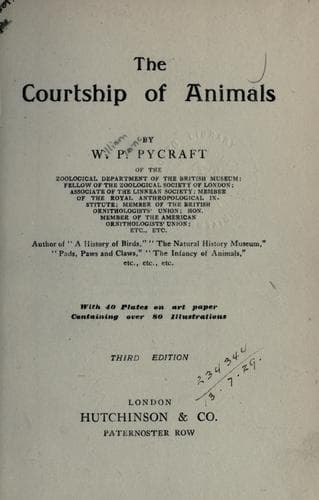
The Courtship of AnimalsPycraft, W. P. (William Plane)
Science
The Courtship of Animals
Pycraft, W. P. (William Plane)
Animal behavior; Natural selection
executioners make no use of their stings; these they might be unable to
withdraw from their victim’s body, in which case they, too, would die.
But there is no need to run this risk, for the males, their brothers,
whom they so cheerfully slay, are unarmed; they may be attacked without
risk. The dreadful work, however, is soon over, and the survivors, the
queen and her daughters, have the house to themselves to make the final
preparations for the winter sleep, which is apparently undisturbed by
qualms of conscience.
There are certain structural differences distinguishing the three types
in such a hive—the queen, the drone and the worker—which must now be
referred to. The queen is larger than the worker; she has a larger
and longer abdomen, a longer and much-curved sting, and her eyes have
fewer facets. Only vestiges remain of the wax-secreting organs, and no
trace is to be found of the wonderful pollen-baskets which perform so
important a function in the worker; and finally, her instincts are of a
very different kind.
The “pollen-basket” of the worker is a strange contrivance. The pollen
is mainly collected by the hairs which clothe the under surface of
the body, from which it is scraped by special brushes of hairs which
clothe the inner surface of the “metatarsus “—the big, flat joint to
which are attached a series of small triangular joints, the last of
which bears the claws. When the brushes are “clogged up,” the legs are
crossed and the pollen is combed out by specially stiff hairs on the
“tibia”—the joint immediately above the metatarsus—and the bolus thus
formed is then transferred to the outer surface of the tibia, which is
trough-shaped, forming the “corbiculum,” or pollen-basket. The next,
or middle, pair of legs are then employed to ram the pollen well into
the basket, for safe conveyance to the hive. On arrival at the combs,
the bee pushes its hind-legs into a cell, or “pollen-tub,” and with a
special spur dislodges the pellet of pollen and lets it fall into the
tub. These are complex movements, performed without instruction and, we
must suppose, without any intelligent conception of their purpose.
The drone is larger than either queen or worker, and has enormous
eyes, which meet one another over the top of the head; he has no
wax-secreting organs, no pollen-basket, no sting. His antennæ are
longer, his hum is deeper, his sole function is to fertilize a queen,
and this done, he promptly dies. Failing in his first flight, he may
make yet other ventures, but the chances are that he will die without
attaining the only purpose for which he exists.
Public-domain text, read in full here on John Shaqi.
Reviews
Reviews
No reviews yet
Be the first to share your thoughts on this work.
Elsewhere in the archive
Join the Discussion
Join the discussion
Sign in to leave a comment or review.
Sign InorCreate an account