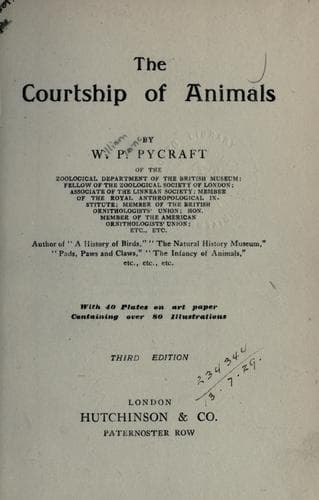
The Courtship of AnimalsPycraft, W. P. (William Plane)
Science
The Courtship of Animals
Pycraft, W. P. (William Plane)
Animal behavior; Natural selection
A characteristic of this pig is the peculiar development of the tusks
in the male, the upper pair of which grow through the lips and curve
upwards.
[Face page 72.]
[Illustration: Plate 11.
_Photo by Lord Delamere, from “The Living Animals of the World.”_
SOMALI ZEBRAS.
The Zebras, unlike their cloven-hoofed relations, have no weapons, save
for inter-tribal conflicts. Yet they have been as successful in holding
their own against lions and other predatory animals as species provided
with horns.
[Face page 72]
[Illustration: Plate 12.
_Photo copyright by A. H. Bishop._
GIRAFFE.
The horns of this animal can prove formidable weapons of offence on
occasion, though they are useless against predatory animals.]
While the ungulates, or hoofed animals, are peculiar in the development
of horns as weapons of offence, they are by no means singular in the
use of teeth for this purpose. In some cases, as in the Muntjac, both
forms of armature are present. The only other instances where teeth
in this group of animals are used for offensive purposes are those
furnished by the Camel and the Horse. But here they do not exhibit
that excessive size which is met with in the Elephant, and some of
the Swine. In both the Camel and the Horse it is the canine which is
used, and both jaws are similarly armed. Since the camel has no upper
incisors, the part played by the teeth is beyond dispute; but it has
been contended that the horse uses his incisor or “front-teeth” alone
when fighting. But this is not so; the canines can, and do, inflict
ugly wounds, as is shown by the necks of zebras.
A further method of defence among the larger Ungulates, at any rate,
is resorted to when hard pressed: and this is the use of the hoof in
kicking. Giraffes kick both after the usual fashion and in striking
downwards with the fore-foot. And an interesting demonstration of this
has been furnished by Mr. F. C. Selous in his delightful “African
Nature Notes.” He relates that on one occasion he came across a calf
only a day or two old, with its back broken. From scratches on the
calf, and the footprints on the ground in its vicinity, he was at once
enabled to gather the cause of its terrible plight. In a word, it had
been attacked by two leopards, and the mother, in an endeavour to beat
off the assailants with a blow of her fore-foot had accidentally struck
her offspring. Horses, Cattle, Antelopes, Camels and Elephants can all
kick with precision and effect. So far as the evidence goes, however,
this is a method of defence used against beasts of prey, and is rarely,
if ever, employed in conflicts between rival males. Females persecuted
by the undesired attentions of amorous males, however, do, as we know
from the case of domesticated animals, use this device to defend
themselves.
Public-domain text, read in full here on John Shaqi.
Reviews
Reviews
No reviews yet
Be the first to share your thoughts on this work.
Join the Discussion
Join the discussion
Sign in to leave a comment or review.
Sign InorCreate an account