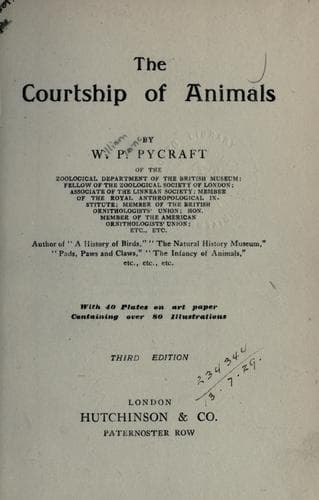
The Courtship of AnimalsPycraft, W. P. (William Plane)
Science
The Courtship of Animals
Pycraft, W. P. (William Plane)
Animal behavior; Natural selection
It is not difficult to account for the origin of such secondary sexual
characters as manes, beards, tusks, and brightly-coloured areas of
skin, though whether our interpretations are really correct is another
matter. But no attempt to explain the origin of horns has yet achieved
a like degree of persuasiveness. These weapons appear only in the
Ungulates, a group which has, in past times, given birth to some very
extraordinary types of head armature of this kind. These must be
excluded from the present discussion; suffice it to say that, as usual,
they were the adjuncts of the males. According to current theories it
is supposed that these weapons arose as the result of the action of
sexual selection. It is assumed that the hornless ancestors of now
horned ruminants fought for their mates by “butting” with the forehead.
Naturally, other things being equal, the thickest skulled combatants
obtained the mastery. Any tendency to develop frontal “bosses” of bone
would further enhance the chances of success, and would, indeed, soon
become necessary for survival. And from such “bosses” the passage to
horns and antlers forms an easy transition. Just such incipient horns
or “bosses” actually make their appearance in the domesticated horse:
but these animals never butt at one another. If, however, we regard
horn-production as an inherent diathesis of the ungulate somatoplasm,
we have an intelligible basis for the explanation of horn development.
The formidable horns of the Rhinoceros are of a totally different
character, being solid structures formed by hairlike agglomerations,
firmly fixed upon a roughened area of the nasal region. These weapons
play a very important part in settling disputes between rival males,
but on other occasions demanding offensive tactics the Indian
Rhinoceros at any rate seems to depend rather on his power of wounding
by means of the chisel-shaped lower incisors. These, by means of a
swift lateral movement of the head can be made to inflict most terrible
gashes, as those who hunt with elephants well know. It is quite
possible, however, that the teeth are also thus used during struggles
for supremacy. And this may perhaps account for the enormous bucklers
of skin developed by the Indian Rhinoceros, but only indicated in the
case of the African species.
All the larger Ungulates, and many of the smaller species, are
polygamous. The Rhinoceros, and all of the swine-group save the
Hippopotamus, among the larger species are exceptions to the rule. The
preponderance of females which this implies is generally supposed to
be due to the losses sustained among the males by fighting during the
struggle for mates. The case of horses, however, seems to militate
against this view, for though they undoubtedly fight furiously, no
evidence is forthcoming to show that such conflicts terminate fatally.
Public-domain text, read in full here on John Shaqi.
Reviews
Reviews
No reviews yet
Be the first to share your thoughts on this work.
Join the Discussion
Join the discussion
Sign in to leave a comment or review.
Sign InorCreate an account