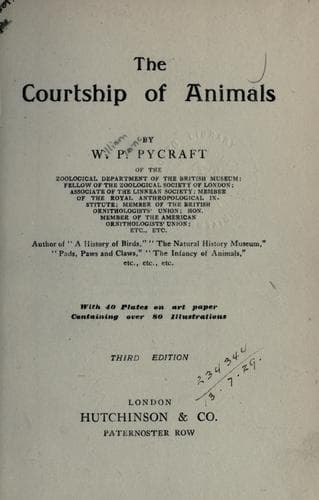
The Courtship of AnimalsPycraft, W. P. (William Plane)
Science
The Courtship of Animals
Pycraft, W. P. (William Plane)
Animal behavior; Natural selection
By nature it would seem the Argus Pheasant is a very solitary bird,
though we must assume it is polygamous. As the breeding season
advances, however, the male proceeds to choose some open space in the
depths of the forest—which it never leaves—and therefrom to clear all
the dead leaves, and twigs, for a space of some six or eight yards
square, so that nothing but the bare earth remains, and thereafter
this area is kept scrupulously clean. Here, in solitary state, for a
short season he remains, calling at frequent intervals to advertise the
fact that an eligible male is in the neighbourhood desiring mates. A
dozen times in succession he will break the stillness of the forest
gloom with a loud, “How-how, how, how, how!” Sooner or later comes a
responsive, “How-owoo, how-owoo!” and in a short time, guided by the
sound, one or more females discover the object of their quest. But the
pairing desire has not yet reached its full intensity, and doubtless to
kindle this the display just described is enacted, and not once, but
a dozen times probably, before the desired state of frenzy has been
aroused. Not seldom another male answers the cry, and this inevitably
leads to a duel whereby the fittest and strongest male is speedily
discovered.
A word as to these ocelli. This pattern is rare among birds, and Darwin
brought to light some extremely interesting facts regarding it. He was
led to investigate the matter by his curiosity as to the meaning of
the notch in the ocelli of the Peacock’s train-feathers. At last he
noticed that among the different species of Peacock Pheasants there was
one (_Polyplectron chinquis_), in which the ocelli were paired, one
lying on either side of the shaft, in another (_P. malaccense_) these
approached and partly fused with one another. Now, to get the indented
ocellus of the Peacock, we have only to imagine the fusion of two such
ocelli, whose long axes inclined obliquely to one another, to get the
“eye” of the Peacock with its indented lower edge; for such fusion
would give a continuous upper and an indented lower border.
The “eyes” of the Argus Pheasant are more interesting still, for, as
Darwin pointed out, these have the appearance, if the feathers are
held more or less vertically, of a number of balls lying each within
a socket, or cup: for each of these balls has a light area which
exactly simulates the light glancing across the upper pole of a sphere,
leaving the rest in shadow; and, singularly enough, this effect is
produced in the living bird only when the feathers are erected for
display. The probable steps in the evolution of these ocelli from
simple spots, and through elliptical bars, Darwin traced with his usual
skill and insight, and those who would follow this up should turn to
that wonderful book, “The Descent of Man.”
[Illustration: Plate 17.
PATTERNS WHICH PUZZLED DARWIN.
Public-domain text, read in full here on John Shaqi.
Reviews
Reviews
No reviews yet
Be the first to share your thoughts on this work.
Elsewhere in the archive
Join the Discussion
Join the discussion
Sign in to leave a comment or review.
Sign InorCreate an account