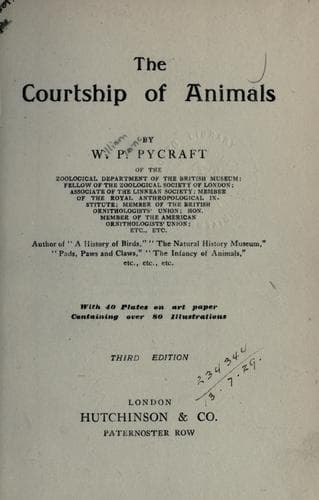
The Courtship of AnimalsPycraft, W. P. (William Plane)
Science
The Courtship of Animals
Pycraft, W. P. (William Plane)
Animal behavior; Natural selection
So far the displays which have been described have been such as
are confined to the use of more or less resplendent plumage. There
are, however, many species which contrive to secure most startling
results, not so much by the parade of coats of many colours as by
grotesque changes of shape produced by wind-bags of various kinds. The
Pouter-pigeon affords a case in point. This bird possesses the power of
inflating the gullet to an enormous size, so as to produce a strangely
distorted form, at any rate, to our eyes. The “Pouter,” it is hardly
necessary to mention, is an artificial product of the “fancier,” who
has taken advantage of the natural tendency, seen in the Wild Pigeon,
to inflate the neck during moments of excitement. By the selection from
each generation of the finest performers in his stock, the Pouter of
to-day has been developed. But there are many birds which, while not
even remotely related, have developed the same strange device. The most
striking illustration of this kind is furnished by the Great Bustard, a
bird once common on the fen-lands of Great Britain, but now, unhappily,
exterminated within these islands.
The means of inflation in this case is afforded by a large thin-walled
sac of a very remarkable character. Opening by a small slit just under
the tongue, it is continued down the front of the neck immediately
under the skin, which in this region is thickened by an accumulation
of fat and blood-vessels. Between the arms of the furcula, or
merry-thought, its cavity is constricted, to expand again immediately
to form a pear-shaped termination. How it is filled is something of
a mystery. But once inflated, the bird draws its neck downwards and
backwards, so that the head is brought to rest between the shoulders
and is there almost buried, partly by pressure on this curious
air-cushion and partly by the erection of a number of bristle-like
feathers, which in calmer moments project backwards on each side of
the head. At the same time the tail is drawn forwards to lie upon the
back, thus exposing a billowy mass of white feathers forming the under
tail-coverts. The tips of the wing-feathers are used to hold the tail
in position. Meanwhile the scapulars are set on end, and the long inner
secondary quills are similarly erected. The feathered contortionist,
having completed his preparations, now approaches his partner with a
mincing gait, then halts before her and solemnly utters a series of
low grunts like “oak, oak, oak.” Having thereby declared his passion,
and commonly without gaining any answering response, he returns to his
normal shape again!
Public-domain text, read in full here on John Shaqi.
Reviews
Reviews
No reviews yet
Be the first to share your thoughts on this work.
Elsewhere in the archive
Join the Discussion
Join the discussion
Sign in to leave a comment or review.
Sign InorCreate an account