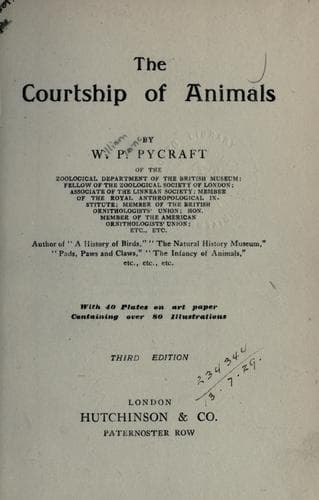
The Courtship of AnimalsPycraft, W. P. (William Plane)
Science
The Courtship of Animals
Pycraft, W. P. (William Plane)
Animal behavior; Natural selection
Preparations for this are begun in the early spring by the assumption
of what is called a “nuptial dress,” which is worn only by the male,
and which contrasts in a very conspicuous manner with the plumage worn
during the rest of the year. The most striking features of this dress
are the great, erectile, Elizabethan ruff which encircles the neck
immediately behind the head, and the long, tongue-shaped “ears” which
surmount the head itself. These exhibit a most remarkable diversity
in their coloration, and it is no exaggeration to say that no two are
ever alike. Red, cream-colour, buff, black, white; spotted, streaked,
freckled and barred are the only descriptions that can be applied to
them, for the combinations of their hues and patterns seem infinite.
Having grasped this fact, the eye next turns to the colouring of the
rest of the body, and it will be found that here too is the same
diversity, though less conspicuously so; and finally it will be noticed
that at this time the feathers around the base of the beak have been
replaced by yellow or orange-coloured papillæ. The females also now
wear a dress differing from that of the so-called “winter plumage,”
but it does not present any very striking features nor any form of
ornamentation comparable to that of the males.
The Ruff is a polygamous bird, which, in its display, presents some
curious and puzzling features, one of which consists of a sort of
tournament between rival males. At the break of day the performers,
selecting such eminences as the fen-lands afford, assemble apparently
to display their finery, for a couple of males will often stand facing
one another with frills erected and beaks touching the ground, silent
and immovable, for perhaps half a minute. Sooner or later, however,
they will commence to spar, and this presently leads to blows, during
which one of the combatants will attempt to seize the other by the
wings. However, no damage seems to be inflicted during such encounters,
which are by no means aimless or profitless, for during such bouts the
weaker, less vigorous birds are driven from the field, and the victor
in consequence wins for himself a larger harem.
Public-domain text, read in full here on John Shaqi.
Reviews
Reviews
No reviews yet
Be the first to share your thoughts on this work.
Elsewhere in the archive
Join the Discussion
Join the discussion
Sign in to leave a comment or review.
Sign InorCreate an account