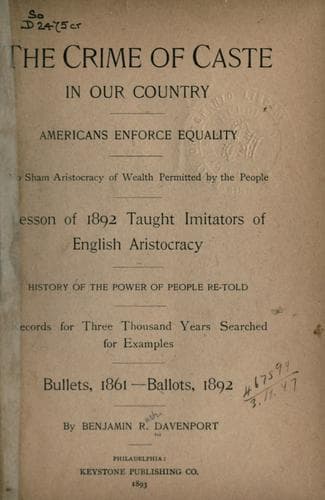
The Crime of Caste in Our CountryDavenport, Benjamin Rush
History
The Crime of Caste in Our Country
Davenport, Benjamin Rush
Social problems; United States -- Social conditions -- 1865-1918
Without entering into the legal aspects of the case, as to whether
these claims be just or not; without assuming to know whether the
nullification proposed by John C. Calhoun was legally sound; without
discussing the question whether South Carolina and the other States of
the South had a _right_ to secede and disintegrate the Union; assuming
that they had the right, inherently, and to draw a parallel to the
assumed Inherent Right of the rich of America under the laws and the
Constitution as they now exist, their attention might be attracted
profitably to the lesson that was taught the minority in the South when
they assumed to exercise Inherent Rights contrary to the wishes of the
majority. 2,800,000 bayonets, with the flag of the Union floating over
them, was conclusive argument that the Inherent Rights claimed by the
Southern States were actually Wrongs in a Republic.
“Vox populi, vox Dei.” The voice of the people, the majority, is the
voice of God in a Republic, from which there is _no appeal_. Seek it,
as the South did in 1861, and the result will be the same. THE MAJORITY
WILL RULE.
Suppose that the Common People should demand a repeal of all the
revenue laws, a repeal of all tariff duties and protection which
did not result in direct benefit to them; suppose that they should
insist that, except so far as protection benefited them (the “Common
People”) by an increase of wages, which should be arrived at by a
fair adjustment of the conflicting interests of capital and labor,
adjusted by a board of arbitration selected by them, the Common People;
suppose that the people should demand that these tremendous incomes
enjoyed by the Vanderbilts, Astors, Goulds, Carnegies, Fricks, and
others, should pay the pensions of the Federal soldiers who fought
for the preservation of the Union; suppose the people should demand
that the expenses of the Federal Government, instead of being levied
upon _them_, should be levied upon the incomes of those who remained
at home in safety during the four years of the Civil War; who, while
far away from the field of battle, have speculated upon the necessities
and needs of the nation, who have utilized that protection, born in
a spirit of patriotic desire to furnish means for the support of the
defenders of the Union, emanating from patriotic principles of the
Abraham Lincoln Republican party; suppose that the people should
demand that they--not out of the accumulated mass, but out of the
interest upon the amount accumulated under existing laws--which said
laws the people, through their representatives, shall deem wise to
change--requiring that in the future these masters of immense wealth
shall contribute a share to the defraying of the expenses of the
Government commensurate with the advantages they have derived, from the
load of debt, in the shape of pensions and otherwise, occasioned by the
Civil War, wherein the Union was preserved.
Public-domain text, read in full here on John Shaqi.
Reviews
Reviews
No reviews yet
Be the first to share your thoughts on this work.
Elsewhere in the archive
Join the Discussion
Join the discussion
Sign in to leave a comment or review.
Sign InorCreate an account