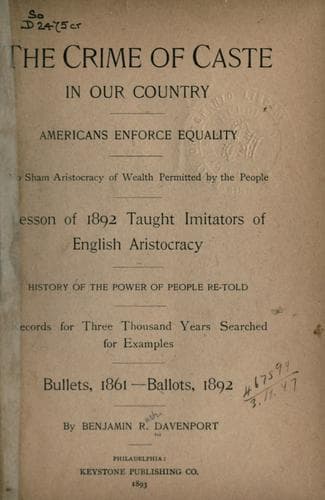
The Crime of Caste in Our CountryDavenport, Benjamin Rush
History
The Crime of Caste in Our Country
Davenport, Benjamin Rush
Social problems; United States -- Social conditions -- 1865-1918
Aristocrats and aristocracy have occasioned, from the beginning of the
world, nearly all of the sins, wretchedness, and misery of the children
of God; and when He sent His Son to save us, they crucified Him. In the
coming of Christ, the “Common People” of Palestine saw a gleam of hope,
a star to guide them to that haven of rest where neither priesthood
nor Romans ruled; that province where all should be bright, where all
should enter into perfect bliss. This sensation among the “Common
People,” starting like the ripples created by casting a stone into
still waters, extended and widened until it permeated every province of
Rome, making converts of the “Common People.”
The conquered provinces had felt the severity of the iron heel of
Rome upon their necks. The Roman nobles had driven so deeply into
the hearts of the conquered the idea that “to be a Roman was to be a
king,” and that the subjugated people, though morally and mentally
often the superiors of the Romans, were, by the power of the Roman
legions, the inferiors of the followers of the eagles of the Cæsars.
The utter uselessness and impotency of any outbreak upon the part of
the subjugated people, where resort to arms would be sought, was so
apparent, the futility of contending with the might of Rome was so
great, that the civilized world at that time was hopelessly suffering.
To contend with the trained and masterful soldiers of the Cæsars
would be productive of but one result--destruction, suffering, and
humiliation.
To the world, so bereft of all hope for relief from their sufferings,
from the oppressive Roman “caste,” His words and His teachings came
like the sweet, refreshing breath of heaven, bringing a salve to the
wounded spirits of the hopelessly oppressed masses. Christ, the Son of
God, was of the people. The earthly parents selected by the All-Wise
Almighty for the Son that He should send to save His people, were of
the lowly. Christ himself learned the trade of His father, and was
a carpenter; His every utterance, His life, the selection of His
disciples, was, like the Truth, democratic. In fact, Christ would
to-day have been pronounced a socialist. In the nineteenth chapter of
St. Matthew, twenty-first verse, we read: “Jesus answered, If thou
wilt be perfect, go and sell that thou hast, and give to the poor.”
In St. Mark, tenth chapter, twenty-first verse: “And Jesus, beholding
him, loved him, and said unto him, One thing thou lackest: go thy way,
sell whatsoever thou hast, and give to the poor.” In St. Luke, twelfth
chapter, thirty-third verse, we find Jesus saying: “Sell that ye have,
and give alms.”
Public-domain text, read in full here on John Shaqi.
Reviews
Reviews
No reviews yet
Be the first to share your thoughts on this work.
Elsewhere in the archive
Join the Discussion
Join the discussion
Sign in to leave a comment or review.
Sign InorCreate an account