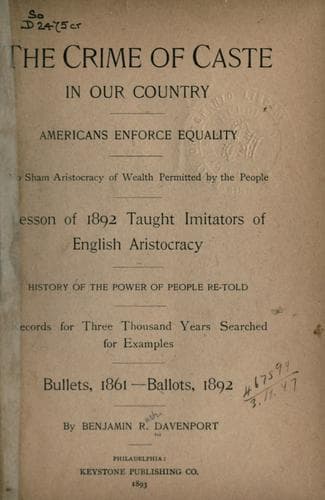
The Crime of Caste in Our CountryDavenport, Benjamin Rush
History
The Crime of Caste in Our Country
Davenport, Benjamin Rush
Social problems; United States -- Social conditions -- 1865-1918
“The victory does mean putting a stop to the riot of extravagance,
profligacy, and corruption. It means the end of the reign of
Plutocracy. It means relief from the monstrous robbery of the
masses by unjust and unnecessary taxation. It means a veto
upon the looting of the Treasury and the hideous waste of
hundreds--nay, thousands--of millions of dollars in the course of
a generation by unmerited pensions. It does mean lower and juster
taxes and larger freedom of trade. It does mean good money, and
good money only.
“Our party has triumphed under the happy union of a great issue
and a great man. The Republic is stronger for this Democratic
victory. The Republicans themselves will be more prosperous, and
in the end happier because of it. Government of the people is
safe in the hands of a great majority of the people.”
In the concluding paragraph of the above editorial of the _World_, we
read (and those of us who live in New York State, with considerable
astonishment): “Our party has triumphed under the happy union of a
great issue and a great man.” To start with, the issue seems to have
been, judging from all of the preceding, Tariff on one side, Free Trade
on the other; National banks on one side, State banks on the other; and
Force Bill as a kind of “Flyer.”
With regard to these “great issues,” there was a lack of unanimity
among even the great newspapers of the Union, at the head of which,
justly and properly, we put the Free Trade New York _World_ and
the Protection New York _Sun_. With regard to the “great man” (and
there is no attempt to disparage in any manner the President-elect
of this nation), it seems somewhat peculiar to use the term “great”
to designate that citizen of the Union who has been selected as
chief magistrate of the nation, in view of the fact that he had been
dubbed the “Stuffed Prophet” by that great organ of Democracy, the
New York _Sun_, and was so heralded through the Union for more than
a year before his nomination. And when four years ago, he sought
re-election, the New York _World_ killed this “great man” by faint
praise. His popularity and greatness did not seem to be recognized
by the seventy-two members of the Democratic National Committee
who represented the State of New York, in the National Democratic
Convention at Chicago, as these representatives protested against the
nomination of their “great” fellow-citizen, declaring that he could
not be elected if nominated; and they represented the politics of the
Democratic party; and they told the truth as far as the Democratic
party was concerned.
By reason of his greatness or his popularity, he could not have been
elected. But when he came before the people, as representing the great
mass of the “Common People,” then he became great, but only great in so
far as he represented the greatness of the people.
Public-domain text, read in full here on John Shaqi.
Reviews
Reviews
No reviews yet
Be the first to share your thoughts on this work.
Elsewhere in the archive
Join the Discussion
Join the discussion
Sign in to leave a comment or review.
Sign InorCreate an account