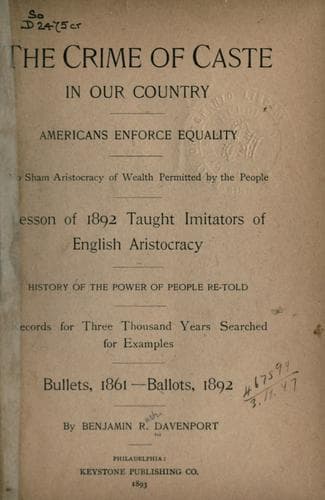
The Crime of Caste in Our CountryDavenport, Benjamin Rush
History
The Crime of Caste in Our Country
Davenport, Benjamin Rush
Social problems; United States -- Social conditions -- 1865-1918
“Those who looked for any definite statement of his policy from
the President-elect in his speech at the Reform Club banquet last
night will be disappointed. Mr. Cleveland evidently thinks, and
probably correctly, that the time for this has not yet come.
“But Mr. Cleveland’s generalities are eminently sound and
patriotic. Especially excellent is his sturdy assertion of the
good Democratic doctrine that the people can be trusted, that
they know what they want, and are entitled to have their will
respected. Contrasted with the current Republican talk that the
voters have been befooled for three years and are bent on turning
the progress of their country backward, Mr. Cleveland’s robust
patriotism and faith are eminently refreshing.
“The spirit in which he contemplates the responsibility soon to
be placed upon him and his party is equally admirable. There
is neither shrinking nor boastfulness, but a calm courage
characteristic of the man and befitting the occasion. It is
to be hoped that Mr. Cleveland’s admonition to and defence of
economy, as something about which ‘there is nothing shabby or
discreditable,’ will not be lost upon the present Congress.”
This fills us with hope, we “Common People,” who regard the _World_ as
a leading light in the Democratic firmament of journalism. It is like a
bow of promise set in the heavens of the future, and especially when,
upon the succeeding day, the _World_, which voices the sentiments of
the Democratic party, publishes the following:--
“A monopoly organ declares that an income tax is ‘undemocratic.’
It says that ‘the only excuse for the income tax was that it was a
war measure,’ and asks: ‘What excuse can be given for reimposing
it?’
“The excuse of necessity. The government is confronted with the
condition of an empty treasury and a demand for tariff reduction
twice made by the people. Either one of these things may make new
taxes necessary. Combined, they are almost certain to do so.
“With an annual expenditure of over $220,000,000 due to the war
(for pensions and interest upon the public debt) a choice in war
taxes would fall on a graded income tax upon every principle of
economy and justice.
“It is surely Democratic to tax luxuries rather than necessaries,
superfluities rather than essentials. As one of the speakers at
the Reform Club said: ‘Any tax on what men have is better than a
tax on what men need.’ It cannot be undemocratic to tax those who
are best able to pay, to apportion public burdens in a manner to
cause the least hardship to the greatest number.
“A graded income tax is the coming tax if the expenditures of the
government are to continue anywhere near the present mark.”
It is with hope and trustfulness that we regard the future.
Public-domain text, read in full here on John Shaqi.
Reviews
Reviews
No reviews yet
Be the first to share your thoughts on this work.
Elsewhere in the archive
Join the Discussion
Join the discussion
Sign in to leave a comment or review.
Sign InorCreate an account