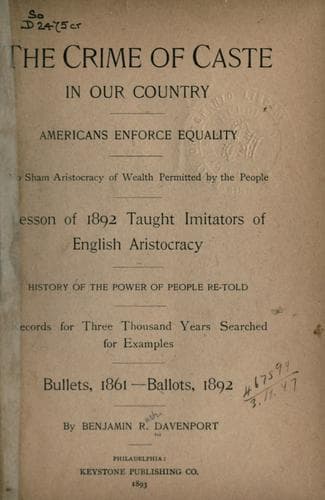
The Crime of Caste in Our CountryDavenport, Benjamin Rush
History
The Crime of Caste in Our Country
Davenport, Benjamin Rush
Social problems; United States -- Social conditions -- 1865-1918
We have been Republicans, we, the “Common People,” until the party for
which we voted in 1860, and which, under the leadership of that great
Commoner, Abraham Lincoln, forever silenced the claim of the Southerner
to social superiority. We have been good Republicans until _you_ have
fostered and aggravated the ulcerous sore of a sham aristocracy,
defiling the healthy and vigorous body of the Republican party. You
may have the best of the argument on Protection; it may benefit our
pocketbooks, but we are not selling our birthright, the equality of
man, for a mess of pottage!
The _Mail and Express_, at great trouble, and, doubtless, expense,
furnished plausible excuses for the defeat of the Republican party, and
disliking to admit the _true cause_, for in admitting that true cause,
it would be necessary to hold the father-in-law of the proprietor
of the newspaper responsible for his share of this “Waterloo.” (In
fact, W. H. Vanderbilt was to the Republican party what Grouchy was
to Napoleon at Waterloo.) With great care did the _Mail and Express_,
saving no expense, ascertain the opinions of the various newspapers
in the State of New York, concerning the cause of the defeat of the
Republican party.
Its columns were filled with the opinions of editors throughout the
Empire State. Many and various were the reasons given. The defeat
was blamed upon the “stay-at-homes”; the defection of the farmers
on account of the McKinley Bill; the Saxton Ballot Law; a simple
desire for a “change”; lack of organization; and a few correspondents
intimated that the “Common People,” tired of accumulations of wealth,
voted the Democratic ticket in the hope of securing relief and equality
thereby.
Could not one editor have been found by the inquiring representatives
of the _Mail and Express_ who possessed sagacity sufficient, coupled
with enough frankness, to say, directly, that it was not against the
policy of the Republican party, their platform, nor candidate, that
the people voted November 8th, but that it was against that element
in society which the proprietor of the _Mail and Express_ represents
so ably as the son-in-law of W. H. Vanderbilt, the sham aristocracy,
snobbery, and the believers in “caste”?
It is not so much a matter of astonishment that the editors of
Republican newspapers should have misjudged with regard to the cause of
the social revolution as it is to find that eminently representative
American, General Benjamin Harrison, the candidate of the Republican
and the present President of the United States, giving expression to
ideas so erroneous as those accredited to him in an interview published
in the New York _World_, November 13, 1892.
Public-domain text, read in full here on John Shaqi.
Reviews
Reviews
No reviews yet
Be the first to share your thoughts on this work.
Elsewhere in the archive
Join the Discussion
Join the discussion
Sign in to leave a comment or review.
Sign InorCreate an account