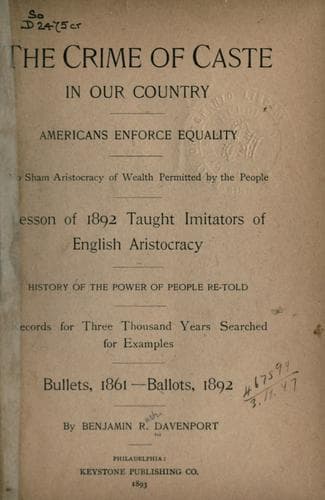
The Crime of Caste in Our CountryDavenport, Benjamin Rush
History
The Crime of Caste in Our Country
Davenport, Benjamin Rush
Social problems; United States -- Social conditions -- 1865-1918
“Mr. Ulman pondered this question for some minutes before he
replied, as though hesitating to convert his general charges
against the Tax Department into a direct personality. But once
having made up his mind, the counsellor sailed into the senior
member of the Tax Commission--Mr. Thomas L. Feitner--with
surprising vigor, handling him without gloves, and winding up with
the suggestion of an appeal to Mayor Grant for his dismissal.
“‘The fact of the matter is,’ said the counsellor, ‘Mr. Feitner
is the entire commission. The two gentlemen associated with him
are comparatively new to the department, and are pushed into the
background and kept there, by this all-wise Pooh Bah.
“‘The Chief Justice and his associates on the bench of the Court
of Appeals have had occasion to chide Feitner in their decisions,
but Feitner will tell you that the Court of Appeals does not
understand tax laws, and that its rulings are not good law.
“‘Special capital is his special prey just at this time. Under
the laws of New York it must be contributed in money and the
amount advertised. This renders Mr. Feitner’s raid upon it a
matter of very simple procedure, and he levies his assessments
upon it whether the status of the property in which the capital
is invested is in Spain, Africa, or New York. Nor does it matter
if the money is invested in imported goods in original packages,
although, by the constitution of the country, such goods are
removed from the jurisdiction of the State’s taxing powers.
“‘But this does not trouble Feitner. He puts his assessments upon
capital so invested, compelling the owner to submit to a taxation
of from ten to fifteen per cent. of his money or go into court by
certiorari and obtain a release at an expense of more than the
amount of illegal tax.
“‘If Mayor Grant desires an equitable and proper administration
of the Tax Office he will dismiss Mr. Feitner and appoint a man
to fill his place who, to say the least, has a knowledge of
commerce, the needs of business, and can understand the plainly
written law when he reads it.
“‘There is another point in this matter which furnishes food for
reflection--namely, the very small number of persons in this city
who are assessed for taxation--less than thirteen thousand out of
a taxable population of nearly one hundred thousand.’”
Public-domain text, read in full here on John Shaqi.
Reviews
Reviews
No reviews yet
Be the first to share your thoughts on this work.
Elsewhere in the archive
Join the Discussion
Join the discussion
Sign in to leave a comment or review.
Sign InorCreate an account