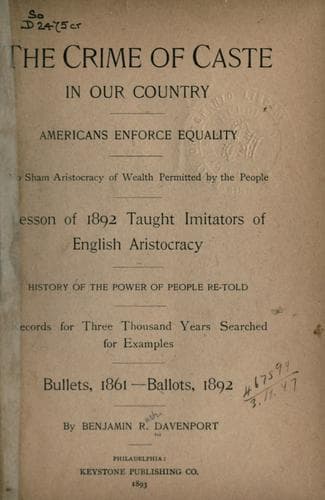
The Crime of Caste in Our CountryDavenport, Benjamin Rush
History
The Crime of Caste in Our Country
Davenport, Benjamin Rush
Social problems; United States -- Social conditions -- 1865-1918
body of the Republican party, all the pure patriotic blood had (in the
opinion of the people) been sucked out of that Grand Old Party, leaving
only a withered skeleton around whose fleshless form was twined in
festoons the venomous serpent of “caste,” imported, like the cholera,
along with much else of evil that comes to this dear land of ours from
Europe.
A small part of owners of villas at Newport and castles in Scotland
will see in this book the expression of opinions which they dub as
dangerous, and declare should entitle the utterer to the treatment
accorded the private soldier who did not sympathize with the tyrannical
Frick in his treatment of the Homestead strikers. This part of our
would-be nobility have always ready in their throats the cry of
“Socialist”--“Anarchist.” With studious care has the author of this
volume insisted upon the fact that the only practical and effectual
method of ridding the land of the curse that would result from the
existence of “caste” here, is by the ballot--by laws enacted to prevent
the accumulation of menacingly large fortunes in the hands of a few
citizens of the Union.
To this part of the pretended “Lords and Barons,” who declare that
truth is sometimes best left unexpressed, and that a man may become
dangerous by giving utterance to the feelings that fill the breasts of
other men, it would be well to consider which is the most efficacious
method to be adopted in dealing with the bite of a mad dog, or a
cancer. Is it by covering it with beautiful silken bandages, and thus
concealing it from view, or is it by cauterization? Does concealment
render the disease less dangerous or deep-seated? Recommending a cure,
and not a curtain to cover the wound which festers all the more rapidly
by the fact that it is heated by the covering, should be the line of
treatment adopted by the good physician of the public body, as of
the individual body. Every party slave may object to the idea of the
victory of the “Common People,” November 8, 1892, being considered
in any light save that of a party triumph. The fact remains just the
same, however; party machination had little to do with results produced
by the people at the last election. There are such positive and
unmistakable indications of the demand of the people for the passage
of a Graded Income Tax, that silence any longer upon the subject is
puerile.
Public-domain text, read in full here on John Shaqi.
Reviews
Reviews
No reviews yet
Be the first to share your thoughts on this work.
Elsewhere in the archive
Join the Discussion
Join the discussion
Sign in to leave a comment or review.
Sign InorCreate an account