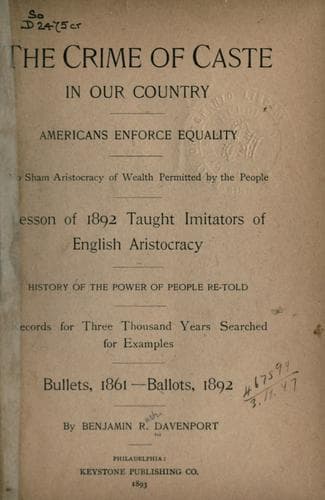
The Crime of Caste in Our CountryDavenport, Benjamin Rush
History
The Crime of Caste in Our Country
Davenport, Benjamin Rush
Social problems; United States -- Social conditions -- 1865-1918
The leading journal in the Force Bill camp had been that preëminently
vigorous newspaper, the New York _Sun_. Under the guidance of the
genius of the Hon. Charles A. Dana, the New York _Sun_ had seized the
most attractive, because the most novel, instrument of noise presented
in this campaign of education. It had blown such vigorous blasts, that
a large portion of newspaperdom, who regarded the opinions expressed
by Mr. Dana as apt to be eminently reasonable, had joined in the
chorus of the Force Bill farce, and created discordance and noise
enough to have nauseated the masses with weariness of the subject. The
pot-house politician, as well as his more exalted brother of the Fifth
Avenue palatial political headquarters, was abashed and confused, by
the fact that his efforts to arouse enthusiasm among the masses were
utterly fruitless. They neither agreed with him nor disagreed with him.
There was no room for argument. It was like the professional pugilist
descanting on the beauties of the bruiser’s art to a Whittier, Holmes,
or Longfellow; the subjects, upon which the politicians of all degrees
and kinds had exhausted themselves, were not interesting.
The issue before the people was sentimental. The detestation of the
prevalence and growth of a pretended and sham aristocracy, became the
important and all-absorbing theme within their hearts. They heard the
talk; they read the dissertations of learned editors, and while it was
all, doubtless, the product of powerful brains, it was not the most
important matter in the struggle to be decided that November morning,
between the masses and an assumption of “caste” in free America.
Mr. Thomas Dolan, at the Clover Club, in Philadelphia, in referring
to the result of the election, had at least the candor to admit the
cause of the Republican party’s defeat. Had he, and gentlemen of his
doubtless aristocratic tendencies, realized the impression that their
course of conduct was making upon the minds of the mass of the Common
People prior to that eventful day, November the 8th, and had they
taken warning by the signs of the times, had they believed less in the
Burchard theory of Blaine’s defeat in ’84, and more in the efficacy of
the impression, prejudicing the minds of the people against Mr. Blaine
and his party by that banquet,--which has been dubbed in political
parlance, “the Belshazzar feast,”--they might have been forewarned. But
those who have been, for the last thirty years, attempting to create
an artificial order to govern society, “caste,” have become so puffed
up by wealth, and blinded by the ever-narrowing view they are able
to obtain from their assumed exalted position, that they have lost
sight of every other consideration; becoming absorbed in their own one
overmastering emotion--love of money. Before this god of Mammon they
had performed such obsequious service, that they imagined the only
appeal necessary to make to the people, was the one so much paraded
by the Republican press, _i.
Public-domain text, read in full here on John Shaqi.
Reviews
Reviews
No reviews yet
Be the first to share your thoughts on this work.
Join the Discussion
Join the discussion
Sign in to leave a comment or review.
Sign InorCreate an account