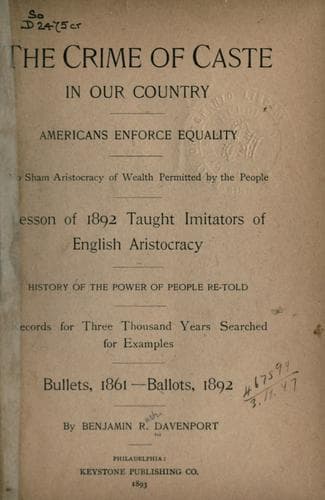
The Crime of Caste in Our CountryDavenport, Benjamin Rush
History
The Crime of Caste in Our Country
Davenport, Benjamin Rush
Social problems; United States -- Social conditions -- 1865-1918
the same surprise and astonishment existed. That Illinois, a State that
had sent over 200,000 men to fight under the Federal flag, and in which
such large sums of pension money had been annually distributed to the
disabled veterans for many years, should have been so unmindful and
heedless of the display of the time-honored and ensanguined garment,
the “Bloody Shirt,” and the howling of the Republican press about
Cleveland’s vetoes of pension bills, was simply outrageous to the minds
of the stupefied Republican leaders.
Could it be possible that their so often victorious shout of
sectionalism, and constant address to the pocketbook of the veteran,
had been relegated to the shadowy shelf of “innocuous desuetude”?
They looked aghast at the result of the counting of votes in Indiana.
That much-talked-of, recently-discovered Gas belt, in which had
sprung up innumerable manufactories, whose workshops were filled with
“Common People,” had failed to find an all-obscuring attraction in
the glittering gold that the magnates of wealth had held out to them
as an inducement to perpetuate the power of the rich and to increase
those privileges and class distinctions that they fondly hoped would
be accorded to them by the American people. Verily, like DeFarge, in
Dickens’ “Tale of Two Cities,” the workman of the manufacturers in
Indiana had presumed to hurl the magical Louis piece back into the
carriages of the wealthy, rejecting with indignation the attempt to
bribe their honor, and their sense of the equality of man.
The negro of Alabama, Georgia, and Virginia, upon whom these
bondholders thought they had a mortgage, by their claimed procurement
of his emancipation, had, even in spite of his color, previous
condition, and gratitude, joined with his fellow-citizens, the “Common
People,” taking as the representative of those who had most benefited
him and his race, the immortal Abraham Lincoln, a man of the “Common
People”; and, by the negro’s vote, was added strength to the blow,
struck by the white Democracy of the Union, at this arrogant assumption
of that thing which the negro, along with the white man, had learned to
hate and resent--the assumption of “caste” upon the part of any set of
citizens in the United States of America.
Public-domain text, read in full here on John Shaqi.
Reviews
Reviews
No reviews yet
Be the first to share your thoughts on this work.
Join the Discussion
Join the discussion
Sign in to leave a comment or review.
Sign InorCreate an account