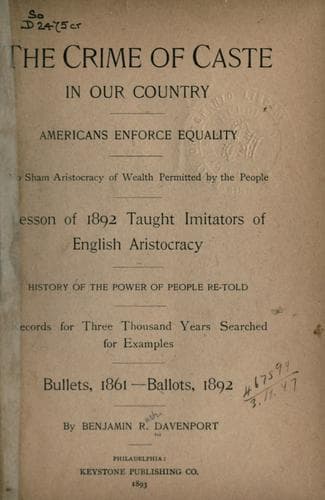
The Crime of Caste in Our CountryDavenport, Benjamin Rush
History
The Crime of Caste in Our Country
Davenport, Benjamin Rush
Social problems; United States -- Social conditions -- 1865-1918
The wool-grower of Ohio, the home of the popular McKinley, added sorrow
to the cup held to the lips of the would-be aristocrats. He no longer
felt bound to bow his head before the advantages held out by the party
of wealth. He preferred to take a little less for his wool, and a
little more respect for himself, his wife, and children in the social
world, where every landmark of equality was being washed away by the
tide of aristocratic tendencies. The bewildered Republican leaders
gazed with terror upon the transmogrified weapons with which they had
waged war. The sword of steel, when held by the hand clad in a golden
gauntlet, had become a weapon of straw. They murmured to one another:
“If these weapons have failed us, in what shall we seek safety?”
Consternation was in the council of the great of that party who, for
more than a quarter of a century, had controlled the legislation of
the Republic, and by whom was created, in the minds of the people,
the errors of social distinction and “caste” that have crept into the
country. The Republicans, assembled at their headquarters, became more
bewildered at each new piece of evidence of the disapprobation and
rejection of those doctrines, the understanding of which they deemed
such conclusive argument to the minds of the people. The oncoming storm
had no centre. It was blowing in all directions of the Union. Illinois,
Indiana, Ohio, even manufacturing Pennsylvania, were sending a
horrible howling of destructive wind, which would sweep away all their
carefully-prepared barriers. At the Democratic headquarters, no less
was the degree of wonder stamped, though with joyous imprint, upon the
faces of the party leaders. Could it be possible that Illinois had cast
the majority of its vote for the leaders of the Democratic party, those
standard-bearers against whom so much had been said to prejudice the
mind of that great Soldier State, the home of Lincoln, the birthplace
of the Republican party and of the Grand Army of the Republic?
It was hard for the most hopeful to realize. Had the vaunted undoing
of the Democratic party in the State of Indiana, the increase of
the manufactures, and the personal popularity of a President, one
of Indiana’s chosen sons, been proved false and groundless? Had the
negroes in Virginia, North Carolina, and Georgia joined the Democratic
“Common People,” in spite of the promised covenant of their salvation,
The Force Bill, and added to the majorities in those Southern States?
Connecticut--much-protected Connecticut; could it be possible that she
would increase the few hundred majority accorded to the Democratic
candidate four years ago?
Public-domain text, read in full here on John Shaqi.
Reviews
Reviews
No reviews yet
Be the first to share your thoughts on this work.
Elsewhere in the archive
Join the Discussion
Join the discussion
Sign in to leave a comment or review.
Sign InorCreate an account