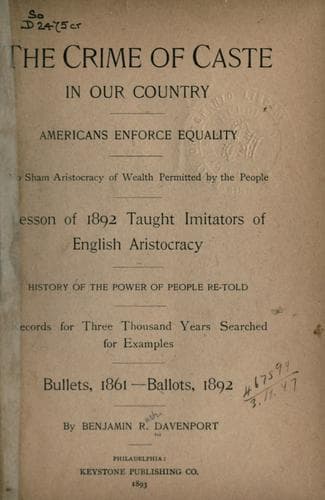
The Crime of Caste in Our CountryDavenport, Benjamin Rush
History
The Crime of Caste in Our Country
Davenport, Benjamin Rush
Social problems; United States -- Social conditions -- 1865-1918
Never was a greater mistake made than in supposing that the influence
of this attempted social distinction shall only influence the laborers
and working classes of a community. In proportion as a man, by increase
of wealth and reputation, acquires in the work-a-day world a higher
position with regard to the influence that he wields in the business
or professional world, just so much more bitterly does he resent
the arrogance of the few, who, like the Patriarchs, would establish
a tribunal to try their fellow citizens concerning their social
positions, at which those outside of the charmed circle have no
opportunity to appear and offer proofs and evidence of their worth and
merit. The banker who finds that his wife has been neglected when the
invitations to the Patriarchs’ ball are distributed, feels as keenly
and resentfully the insult as does the longshoreman upon finding that
his wife has not been invited to the butchers’ ball.
Be honest with yourselves, and you will find, down in your hearts, a
very ocean of bitterness occasioned by some slight or insult inflicted
upon your family; and these are the things to which men do not give
words, but which are silently felt, and to change which men silently
voted.
American men bestow upon the women of their families a degree of
devotion and admiration greater than that given by foreigners generally
to their families. The Americans have exalted the women of our
land, irrespective of wealth or condition, to a position of so much
pre-eminence in our social affairs, that in that department of our
lives our women are permitted to have absolute sway and control.
A man who dawdles around society, permitting it to absorb his time and
attention, loses in a certain degree the respect of the large mass of
American men. He is considered rather effeminate. Our social lives are
controlled by the woman. Our opinions are moulded by her; hence, we
feel that, on subjects of a social nature, her judgment, opinions, and
thoughts are entitled to the greatest respect--in fact, controlling
largely our own. Hence the mighty influence of the women who had become
resentfully Democratic because of social snubs. One woman had not been
invited to the Patriarch’s ball; another to the railroad magnate’s
ball; another to the Standard Oil Company king’s entertainment; and,
so on, it runs all down through the different stages created by this
attempted crime of “caste,” leaving behind it a sting in the hearts of
each home as it passes, until it reaches the laborer and strikes him
and his with telling force and effect. The Fricks, Carnegies, Goulds,
Vanderbilts, Astors, become names as hateful to him as Tarquin’s ever
was to the Roman “Common People.”
[Illustration: WARD MacALLISTER.
Self-Appointed Leader of the “Four Hundred” of New York.
“A Prince of Cooks and Coats.”]
CHAPTER V.
SOME REASONS FOR WRATH.
Public-domain text, read in full here on John Shaqi.
Reviews
Reviews
No reviews yet
Be the first to share your thoughts on this work.
Elsewhere in the archive
Join the Discussion
Join the discussion
Sign in to leave a comment or review.
Sign InorCreate an account