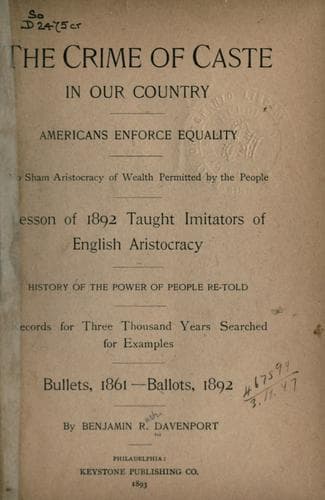
The Crime of Caste in Our CountryDavenport, Benjamin Rush
History
The Crime of Caste in Our Country
Davenport, Benjamin Rush
Social problems; United States -- Social conditions -- 1865-1918
“Chappie,” after his late and dainty breakfast and stroll down Fifth
Avenue (every city has its Fifth Avenue or something like it), enabling
the daughters of the poor to gaze upon his charming proportions;
delighting their fancy with the possibility in the shape of finery
that might be theirs would he only condescend to beckon to them; with
a few chosen spirits similar to himself--all of the “smart set,”
y’ know!--seeks that most discriminating and select of saloons,
Delmonico’s. (And every city has its Delmonico.) There, after tickling
his palate and tempting his satiated appetite with delicacies so rare
and difficult of procurement that the cost of each one of such dainties
would feed some poor man’s family for a fortnight; forgetting that
early grandfather, the fur trader, who considered pork a feast, leans
back in his chair and lisps in affected imitation of the English,
“Where shall we g-o, deah boys?”
Now let us draw the veil over where “Chappie” spends his evenings.
“Chappie’s” pleasures and “Chappie’s” unnatural amusements would cause
a blush of shame to redden the face of the humblest horny-handed son
of toil. “Chappie’s” exhausted nature has ceased to realize sensations
natural to _men_ and sons of God. “Chappie” is much poorer than his
progenitor, the old fur trader; for the old fur trader was rich in
all the natural inclinations and appetites created by a natural
and vigorous manhood. The old fur trader had no coat-of-arms; but,
“Chappie,” that old fur trader would blush at the decadence of his own
descendant! When the historian, “Chappie,” shall make up the records
of this great nation, that old fur trader, though he swindled the
Indians and debauched them with rum, had that which you, “Chappie,”
lack--manliness, courage, and character, even though the character was
of a peculiar kind.
You have no character, “Chappie.” The Common People have found you a
tumor, an excrescence upon the body politic. They have taken their
knife to amputate, from wholesome Americanism, a foreign infliction. Be
careful, “Chappie,” that the amputation does not include the severance
of that semblance of a head that you carry on your sloping shoulders.
Be warned in time; you and yours have wealth, luxury, influence, and
obedience upon the part of those you dominate. You have all that wealth
will buy--villas at Newport, yachts, palaces. You revel in banquets,
balls, and glittering assemblages. The poor man’s home is illuminated
alone by the light shed by honor. He who would steal or deprive him
of that one light, takes all from him that makes his life worth the
living. The poor man’s honor is the honor of his wife and children.
Your immoralities have increased, like appetite, by what they fed upon.
It is not after you, the deluge, but it is around you, the deluge. It
is in the air, because it is in the hearts of the Common People.
Public-domain text, read in full here on John Shaqi.
Reviews
Reviews
No reviews yet
Be the first to share your thoughts on this work.
Elsewhere in the archive
Join the Discussion
Join the discussion
Sign in to leave a comment or review.
Sign InorCreate an account