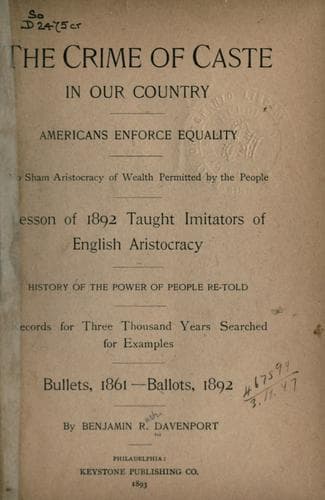
The Crime of Caste in Our CountryDavenport, Benjamin Rush
History
The Crime of Caste in Our Country
Davenport, Benjamin Rush
Social problems; United States -- Social conditions -- 1865-1918
What a contrast is presented when we shift “Chappie” from the scene of
our mental vision and bring forth the loved “Harry” Clay, the miller’s
boy. That barefoot boy, on a bony, ill-bred horse, with shaggy mane
and tail; holding a bag of corn in front of him, on his journey to the
mill for his widowed mother, is a more inspiring picture, decidedly,
than “Chappie” on his well-bred English cob whose coat is soft as fur
from constant currying, whose tail is cropped off _a la_ the fashion
for riding-horses in London. As “Chappie” sits on his little imported
English saddle, and daintily holds an imported English riding whip,
prepared for a ride, to give the “Common People” an exhibition of the
beauty, gallantry and horsemanship of the scion of sham aristocracy;
with all his glory, backed with all of his millions, “Chappie” does
not warm the hearts of the “Common People” like the picture of that
miller’s boy, Henry Clay, the great Commoner of Kentucky.
Daniel Webster, struggling as district school teacher in New England,
clothed in ill-fitting garments, would somehow furnish a better model
for the sculptor or painter who would make a statue or picture or a
head of him who was, indeed, a mighty man.
The music of the voice of grand old Daniel Webster, even though he did
not drawl in delightful imitation of the English, would give greater
delight to the “Common People,” plebeian as they are and unrefined,
than “Chappie’s” lispings.
There remains another figure, called to mind by the Common People
when they view “Chappie,” by reason of the vast difference between
the figure of “Chappie” and the “rail-splitter” of Illinois. The
long, uncouth, gangling, ungainly figure of a boy sprawled on his
back, lying on the floor of a humble log-cabin, seeking knowledge
in a well-thumbed book, by the light of a flickering fire, presents
something that speaks more eloquently to the hearts of the Common
People than “Chappie’s” gorgeous appearance and apparel; for they know
that the name of the lad before that fire was ABRAHAM LINCOLN, and that
from that uncouth figure, and by the aid of that difficultly-acquired
knowledge, resulted the production of that man who, as representative
of the Common People as their President, stood as the Rock of
Gibraltar when the fierce waves of fratricidal war swept over our
land; immovable, firm and unchangeable as that rock itself in the
determination that the Union should be preserved, and that the Stars
and Stripes should float over every inch of ground of the United States
of America. While others lost hope and many were downcast, groping for
support in the hour of gloom and peril to the national existence of our
country, that man, who was the outcome of the ungainly figure by the
fire, led the people of the nation as the pillar of fire of old led the
hosts of Israel.
Public-domain text, read in full here on John Shaqi.
Reviews
Reviews
No reviews yet
Be the first to share your thoughts on this work.
Elsewhere in the archive
Join the Discussion
Join the discussion
Sign in to leave a comment or review.
Sign InorCreate an account