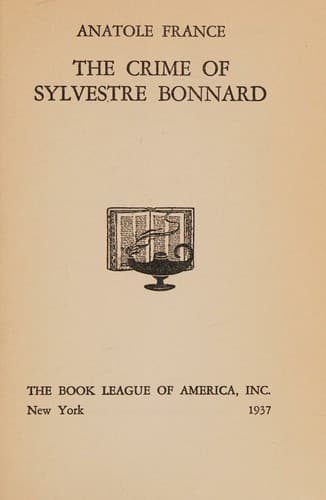
Book collectors -- Fiction; Detective and mystery stories; France -- Fiction
“In the first place,” he says to me, “what is history? The written
representation of past events. But what is an event? Is it merely
a commonplace fact? It is any fact? No! You say yourself it is a
noteworthy fact. Now, how is the historian to tell whether a fact is
noteworthy or not? He judges it arbitrarily, according to his tastes and
his caprices and his ideas--in short, as an artist? For facts cannot by
reason of their own intrinsic character be divided into historical facts
and non-historical facts. But any fact is something exceedingly complex.
Will the historian represent facts in all their complexity? No, that is
impossible. Then he will represent them stripped of the greater part
of the peculiarities which constituted them, and consequently
lopped, mutilated, different from what they really were. As for the
inter-relation of facts, needless to speak of it! If a so-called
historical fact be brought into notice--as is very possible--by one or
more facts which are not historical at all, and are for that very reason
unknown, how is the historian going to establish the relation of
these facts one to another? And in saying this, Monsieur Bonnard, I am
supposing that the historian has positive evidence before him, whereas
in reality he feels confidence only in such or such a witness for
sympathetic reasons. History is not a science; it is an art, and one
can succeed in that art only through the exercise of his faculty of
imagination.”
Monsieur Gelis reminds me very much at this moment of a certain
young fool whom I heard talking wildly one day in the garden of the
Luxembourg, under the statue of Marguerite of Navarre. But at another
turn of the conversation we find ourselves face to face with Walter
Scott, whose work my disdainful young friend pleases to term “rococo,
troubadourish, and only fit to inspire somebody engaged in making
designs for cheap bronze clocks.” Those are his very words!
“Why!” I exclaim, zealous to defend the magnificent creator of ‘The
Bride of Lammermoor’ and ‘The Fair Maid of Perth,’ “the whole past lives
in those admirable novels of his;--that is history, that is epic!”
“It is frippery,” Gelis answers me.
And,--will you believe it?--this crazy boy actually tells me that no
matter how learned one may be, one cannot possibly know just how men
used to live five or ten centuries ago, because it is only with the very
greatest difficulty that one can picture them to oneself even as they
were only ten or fifteen years ago. In his opinion, the historical poem,
the historical novel, the historical painting, are all, according to
their kind, abominably false as branches of art.
Public-domain text, read in full here on John Shaqi.
Reviews
Reviews
No reviews yet
Be the first to share your thoughts on this work.
Elsewhere in the archive
Join the Discussion
Join the discussion
Sign in to leave a comment or review.
Sign InorCreate an account