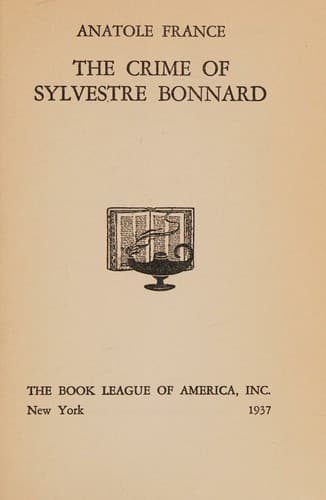
Book collectors -- Fiction; Detective and mystery stories; France -- Fiction
Page eighty-seven.... Only twenty lines more and I shall have finished
my book about insects and flowers. Page eighty-seventh and last.... “As
we have already seen, the visits of insects are of the utmost importance
to plants; since their duty is to carry to the pistils the pollen of
the stamens. It seems also that the flower itself is arranged and made
attractive for the purpose of inviting this nuptial visit. I think I
have been able to show that the nectary of the plant distils a sugary
liquid which attracts the insects and obliges it to aid unconsciously
in the work of direct or cross fertilisation. The last method of
fertilisation is the more common. I have shown that flowers are coloured
and perfumed so as to attract insects, and interiorly so constructed as
to offer those visitors such a mode of access that they cannot penetrate
into the corolla without depositing upon the stigma the pollen with
which they have been covered. My most venerated master Sprengel
observes in regard to that fine down which lines the corolla of the
wood-geranium: ‘The wise Author of Nature has never created a single
useless hair!’ I say in my turn: If that Lily of the Valley whereof the
Gospel makes mention is more richly clad than King Solomon in all his
glory, its mantle of purple is a wedding-garment, and that rich apparel
is necessary to the perpetuation of the species.”
“Brolles, August 21, 1869.”
[Monsieur Sylvestre Bonnard was not aware that several very illustrious
naturalists were making researches at the same time as he in regard to
the relation between insects and plants. He was not acquainted with
the labours of Darwin, with those of Dr. Hermann Muller, nor with
the observations of Sir John Lubbock. It is worthy of note that the
conclusions of Monsieur Sylvestre Bonnard are very nearly similar to
those reached by the three scientists above mentioned. Less important,
but perhaps equally interesting, is the fact that Sir John Lubbock is,
like Monsieur Bonnard, an archaeologist who began to devote himself only
late in life to the natural sciences.--Note by the French Editor.]
Brolles! My house is the last one you pass in the single street of the
village, as you go to the woods. It is a gabled house with a slate roof,
which takes iridescent tints in the sun like a pigeon’s breast. The
weather-vane above that roof has won more consideration for me among the
country people than all my works upon history and philology. There is
not a single child who does not know Monsieur Bonnard’s weather-vane. It
is rusty, and squeaks very sharply in the wind. Sometimes it refuses
to do any work at all--just like Therese, who now allows herself to be
assisted by a young peasant girl--though she grumbles a good deal about
it. The house is not large, but I am very comfortable in it. My room
has two windows, and gets the sun in the morning. The children’s room is
upstairs. Jeanne and Henri come twice a year to occupy it.
Public-domain text, read in full here on John Shaqi.
Reviews
Reviews
No reviews yet
Be the first to share your thoughts on this work.
Elsewhere in the archive
Join the Discussion
Join the discussion
Sign in to leave a comment or review.
Sign InorCreate an account