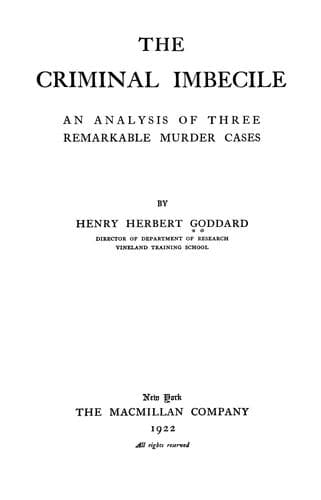
The Criminal Imbecile: An Analysis of Three Remarkable Murder CasesGoddard, Henry Herbert
Science
The Criminal Imbecile: An Analysis of Three Remarkable Murder Cases
Goddard, Henry Herbert
Crime -- Case studies; Murder -- Case studies; Offenders with mental disabilities -- Case studies
Fred Tronson is in prison for life. He will in all probability never be
pardoned. He will never have an opportunity to commit another murder. But
that does not restore the life of Emma Ulrich and it is small comfort to
her friends and relatives. It does not in the least remove the blot upon
society, which has allowed such a murder to be committed. Society should
have taken him in hand twelve years ago. It should be further noted that
Tronson had been before the Court at least once before he committed this
crime. At that time had the Judge realized that he was dealing with an
imbecile he might have sent the boy to an institution for the
feeble-minded instead of simply ordering him to leave the town. Shall we
learn the lesson and take care of the other Fred Tronsons who are now in
our public schools and on our streets?
CHAPTER IV
THE CRIMINAL IMBECILE
From the description already given it will be seen that Roland Pennington
is very different from Jean Gianini. Both are imbeciles, but each is an
example of a special type. Gianini is of a nervous, impulsive, irritable,
loquacious type, fond of show and excitement, a braggart and a coward,
with an excellent memory, a great reader--particularly interested in
stories of excitement and crime. Pennington, on the contrary, is a slow,
dull, relatively stupid boy, of poor memory and slow perception. While
having made the fifth grade in school work, he has done it slowly and with
not so much success as in the case of Gianini. He is not so much given to
talk or to showing off; is somewhat addicted to drink and is exceptionally
fond of playing pool.
Gianini's confession is colored by his desire to show off and shine in the
limelight; Pennington's, on the contrary, is a plain, unelaborated
statement of the facts. He is driven to his confession, not by his desire
to show off, but in self-defense. His colleague, March, is trying to throw
the entire responsibility upon him in order to escape from any
condemnation. In the face of this Pennington is prompted to tell his own
story. He is not intelligent enough to make up a plausible story which
would incriminate March and save himself. But in telling the facts as they
occurred he incriminates himself quite as much as March, so far as the
actual occurrences are concerned. His whole conduct, from the beginning of
the crime until his arrest, is that of a dull, stupid person. He does not
even wield the blackjack with intelligence, and after the man is killed by
his comrade, he takes no precaution to save himself from suspicion, to
dispose of the body or to clean up about the barn and remove the evidences
of a crime. And finally, when it comes to a statement of the case, he
apparently makes no attempt to shield himself, but acknowledges his part
in it, although that part was, as a matter of fact, so slight that a
little variation in his testimony would have thrown the entire burden upon
March and relieved him from any complicity in the matter.
Public-domain text, read in full here on John Shaqi.
Reviews
Reviews
No reviews yet
Be the first to share your thoughts on this work.
Join the Discussion
Join the discussion
Sign in to leave a comment or review.
Sign InorCreate an account