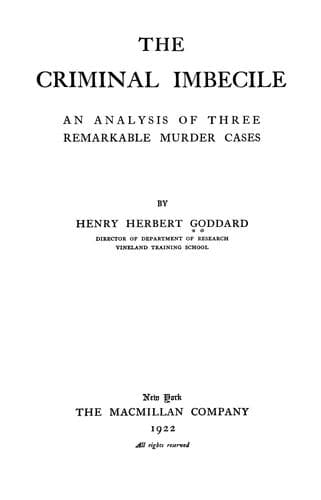
The Criminal Imbecile: An Analysis of Three Remarkable Murder CasesGoddard, Henry Herbert
Science
The Criminal Imbecile: An Analysis of Three Remarkable Murder Cases
Goddard, Henry Herbert
Crime -- Case studies; Murder -- Case studies; Offenders with mental disabilities -- Case studies
If the foregoing statement of the case is correct, we ask at once, how it
happened that the jury did not see it in this light, but instead brought
in a verdict of "Guilty in the first degree"? While there are many
elements in the answer, such as the demand of the public for revenge on
the murderer of the man who was more or less of a favorite; a hastily
drawn jury; a hurried trial, etc., the burden of the explanation falls
back upon the same condition which we discovered in the case of Gianini,
namely, the ignorance of the general public in regard to this type of
feeble-mindedness. Almost every one thinks that he knows an imbecile. We
have so long considered these high-grade cases as _normal but vicious_
persons, that it is difficult to change the point of view suddenly and
realize that they are not responsible for their deeds.
This failure to recognize the high-grade type of imbecile extended even to
the "experts" in the case; for whereas there were three who testified to
the feeble-mindedness of the prisoner, there were four or five who
testified to his normality. These were four general practitioners of
medicine, including the jail physician, and the fifth, a professor of
neurology and neuropathology. These gentlemen are all familiar with what
we should call the low-grade type of imbecile. They were perfectly correct
in declaring that Roland Pennington is not a low-grade imbecile. Not one
of them had had experience with the high-grade type. They were,
therefore, not qualified to pass upon a case of this kind. It was as
though four general practitioners had been brought in to decide a case of
obscure insanity. Every one of them could have testified that he had had
more or less to do with insane people, meaning persons who are maniacal or
strongly melancholic or katatonic, but what would be the value of the
testimony of such men in such a case, for instance, as that of Thaw?
These men all thought they knew something about high-grade
feeble-mindedness. They all testified that Pennington was a normal man.
Compare this with the statement of Dr. Martin W. Barr, one of the foremost
authorities on feeble-mindedness in the United States--indeed, in the
world. Dr. Barr says (_Alienist and Neurologist_, November, 1914, page
367):--
"The courts simply do not go far enough back; they fail in that they do
not reach the inception--the root of the matter. They often punish without
careful investigation of the causes from which criminal instinct
springs--the environment, family history, inherited tendencies, physical
disability, and that susceptibility to suggestion which makes them the
ready tools of the vicious.
Public-domain text, read in full here on John Shaqi.
Reviews
Reviews
No reviews yet
Be the first to share your thoughts on this work.
Join the Discussion
Join the discussion
Sign in to leave a comment or review.
Sign InorCreate an account