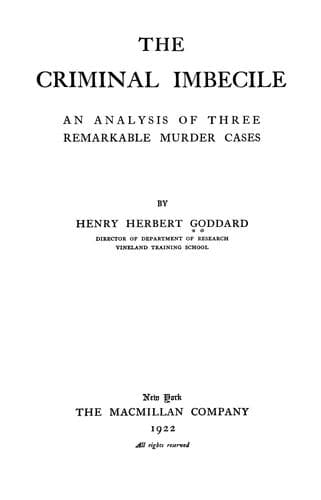
The Criminal Imbecile: An Analysis of Three Remarkable Murder CasesGoddard, Henry Herbert
Science
The Criminal Imbecile: An Analysis of Three Remarkable Murder Cases
Goddard, Henry Herbert
Crime -- Case studies; Murder -- Case studies; Offenders with mental disabilities -- Case studies
When this confession was read to the jury, Tronson leaned over and asked
the clergyman, "Well, what do you think of it?" When the verdict of the
jury was given, he did not understand what it meant and asked to be told.
When he was answered, he showed no appreciation of its significance, but
remarked that there wasn't so much of a crowd out as at the trial.
This is the third case in which the Binet tests have been admitted in
evidence and the findings in accordance with these tests practically
accepted. No one seems to have denied that Tronson is an imbecile. He is
of lower grade than the other two that we have discussed, and enough lower
so that his defectiveness was much more apparent and easily admitted by
all of the judges. As will be noted, there was no reasonable motive for
the crime. In his own words: "She wouldn't marry me. That's why I killed
her--so that no one else could have her." In the case of Gianini we are
possibly dealing with the sex impulse, perhaps hardly recognized even by
the criminal himself. In Tronson's case we have that impulse definitely
recognized and asserting itself and, being uncontrolled, leading to an
action of the crudest and most savage kind. Under other conditions, it
would very likely have shown itself in a different way. If Tronson could
have gotten the girl off by herself, it is very probable that he would
have committed violence in the gratification of his sex impulse. But since
she refused to marry him and kept out of his reach, he shot her down in
order that "no one else could have her."
It is unnecessary to discuss the case further. We need nothing more to
convince us that the diagnosis of imbecility was correct. It remains only
to point out two facts. First, that this man has been an imbecile at least
since he was twelve years of age, that he could have been recognized as an
imbecile and cared for, and thus this atrocious murder prevented. Second,
that there are hundreds of just such persons, now in their youth, who are
potential criminals. Unless their mental condition is recognized and they
are cared for in such a way as to make crime impossible, many of them will
repeat the career of Tronson.
Public-domain text, read in full here on John Shaqi.
Reviews
Reviews
No reviews yet
Be the first to share your thoughts on this work.
Join the Discussion
Join the discussion
Sign in to leave a comment or review.
Sign InorCreate an account