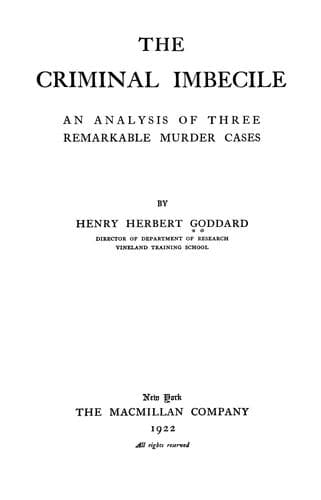
The Criminal Imbecile: An Analysis of Three Remarkable Murder CasesGoddard, Henry Herbert
Science
The Criminal Imbecile: An Analysis of Three Remarkable Murder Cases
Goddard, Henry Herbert
Crime -- Case studies; Murder -- Case studies; Offenders with mental disabilities -- Case studies
"In the case of Roland Pennington, tried in Media last June, for aiding
in the murder of a man, it was proven that the boy, although almost twenty
in actual age, yet coming from a neurotic stock, with three first cousins
imbecile, had mentally only attained some 11 or 12 years; still he was
adjudged responsible, and murder in the first degree was the verdict.
"Is it not a poor law that first permits a person to commit a crime, and
then punishes him for it, not recognizing that an ounce of prevention is
worth a pound of cure?
"Pennington had sufficient intelligence to comprehend the enormity of the
deed, but, susceptible to suggestion in exaggerated degree, he had not
sufficient inhibition to resist the volitional act.
"Early recognition of his mental defect and separation would have
protected him alike from tempter and temptation."
It is unfortunate that Dr. Barr did not testify in the case, but his
assistant did testify and was understood to express Dr. Barr's views.
It was unfortunate, indeed, that men who really knew so little about the
type of case before them were allowed to pass as experts and their opinion
allowed to carry more weight with the jury than the opinion of those who
have spent years in intimate association and study of the problem of
high-grade imbecility. It should be recognized that there are very few
persons who are expert with this type. The superintendents of our
institutions for the feeble-minded, after a few years of experience, have
a knowledge of this matter which far surpasses that of any physician who
has not had institution experience, however great a specialist he may be
in nerve diseases, in insanity or epilepsy. It is not enough to find out
that a physician has had some experience with imbeciles. The real problem
is: Has he had experience with this high-grade type? Is he able to pick
them out? Is his knowledge as well as his experience confined to the
medium and low grades, which every one meets? Failure to make this
distinction had much to do with the verdict in the case of Pennington.
Public-domain text, read in full here on John Shaqi.
Reviews
Reviews
No reviews yet
Be the first to share your thoughts on this work.
Join the Discussion
Join the discussion
Sign in to leave a comment or review.
Sign InorCreate an account