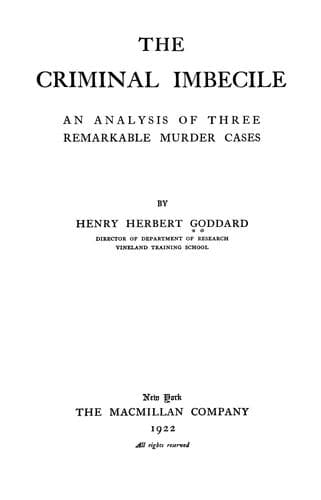
The Criminal Imbecile: An Analysis of Three Remarkable Murder CasesGoddard, Henry Herbert
Science
The Criminal Imbecile: An Analysis of Three Remarkable Murder Cases
Goddard, Henry Herbert
Crime -- Case studies; Murder -- Case studies; Offenders with mental disabilities -- Case studies
All students of the psychology of childhood agree that not until the dawn
of adolescence does reasoning as such begin to show itself in the child
mind; that judgment and foresight and self-control, such as enable a
person to counteract his natural impulses and make himself fit into the
conventions of society, are practically unknown previous to this age. It
is true that many children are taught to say what the adult alone can feel
in connection with such matters. But as for having the real feeling and
the understanding of the situation, we seem to have no right to expect it
before the beginning of this adolescent period, from twelve to fifteen
years of age. Everything points to the correctness of the conclusion that
during this early period of pre-adolescence the child is a creature of
impulse and instinct and is controlled largely by counteracting one
instinct by another. For example, the instinct to love and obey a parent
impels the child to do what that parent says, when he tells him not to
yield to some impulse which would lead him into trouble according to the
canons of modern society. Without going further into a discussion of the
point, which would necessarily lead to many philosophical considerations,
the writer may express his conviction, born of a study both of normal
children and also of mental defectives of twelve years and under in
mentality, that persons of this mentality do not know much about right and
wrong. They act upon impulse and upon instinct, without very much thought.
Even the child of the best opportunity and the most elaborate training in
a good home may quite likely not know the wrongfulness of an act of
homicide in the sense of having a real feeling of that wrong. He can
doubtless, as already stated, _say_ that the thing is wrong, because he
has learned that this is the right thing to say.
Public-domain text, read in full here on John Shaqi.
Reviews
Reviews
No reviews yet
Be the first to share your thoughts on this work.
Join the Discussion
Join the discussion
Sign in to leave a comment or review.
Sign InorCreate an account