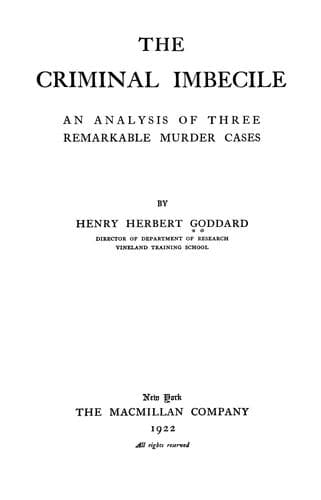
The Criminal Imbecile: An Analysis of Three Remarkable Murder CasesGoddard, Henry Herbert
Science
The Criminal Imbecile: An Analysis of Three Remarkable Murder Cases
Goddard, Henry Herbert
Crime -- Case studies; Murder -- Case studies; Offenders with mental disabilities -- Case studies
Let us turn now to the other part of the legal phrase, "Does such a person
know the nature and quality of his act?" If the writer understands these
terms, the first may be translated into the expression, "Does he know what
he is doing?" We take it that the expression originated in the attempt to
cover those cases where persons, either momentarily or permanently
deranged, literally do not know what they are doing. If this is correct,
then one cannot, as a rule, say that a high-grade imbecile does not know
what he is doing. He is not like the lunatic who acts blindly and is
probably no more responsible for his acts than a person walking in his
sleep. The imbecile is not in this condition. He has, so to speak, full
possession of all the mind that he has ever had and that, in the case of
these high-grade imbeciles or morons, is certainly sufficient to enable
him to know what he is doing. In the case of Jean Gianini, the writer
testified that in his opinion he knew what he was doing. He knew the
nature of his act. One cannot speak, it is true, with certainty in such
cases. It is entirely possible that, as already intimated, the situation
at first may have been a simple altercation or discussion which finally
got to a point where the anger of the boy was aroused to such an extent
that he acted without really knowing what he was doing. However, there is
no more argument for that theory than against it, and without definite
evidence on the question it is probably going too far afield to make any
such claims of immunity on that ground. We are frank to admit that the
probabilities are high that the boy knew the nature of his act. Did he
know the quality of his act?
By the quality of a thing is meant that which distinguishes it from all
other things. This implies a complete and extensive knowledge of the thing
in question. To know the quality of an act--murder, for example--means to
know all of the elements, forms, or modes of being or action which seem to
make it distinct from all other acts. To know the quality of an act of
murder is to know that it is unjustifiable; it is to know that it differs
from the killing of a rat in that different consequences follow; that
human suffering is involved, both that of the victim and of the victim's
friends and associates. It is to know, at least in some vague way, that
human society could not exist if murder were the rule. To know the quality
of an act of murder is to know enough to be able to distinguish it from
justifiable homicide, from killing in war, not to mention more obvious
necessary distinctions.
Public-domain text, read in full here on John Shaqi.
Reviews
Reviews
No reviews yet
Be the first to share your thoughts on this work.
Elsewhere in the archive
Join the Discussion
Join the discussion
Sign in to leave a comment or review.
Sign InorCreate an account