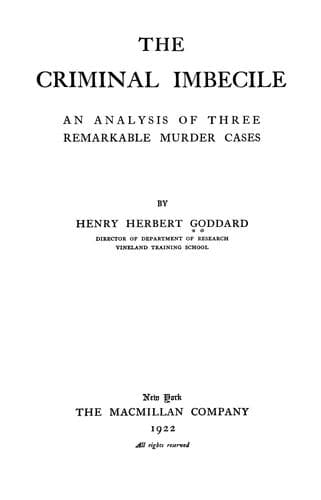
The Criminal Imbecile: An Analysis of Three Remarkable Murder CasesGoddard, Henry Herbert
Science
The Criminal Imbecile: An Analysis of Three Remarkable Murder Cases
Goddard, Henry Herbert
Crime -- Case studies; Murder -- Case studies; Offenders with mental disabilities -- Case studies
After all, what we want is protection for society. We cannot have innocent
people killed in accordance with the whim of the irresponsible. These
imbeciles have killed innocent members of society. What shall the living
do to prevent these particular persons from repeating the crime and to
prevent other imbeciles from ever committing such a crime? This, of
course, involves the whole problem of punishment or the treatment of the
wrongdoer. Upon one thing everybody is agreed--we must make it impossible
for these persons ever to do such a deed again. The surest way to
accomplish this is to destroy them. Dead men commit no crimes. Society
feels safe when a desperado is killed. If we can agree upon this solution,
the problem is easily solved and further discussion is unnecessary. But
society is not at one on this question. We are already seriously debating
the question whether any wrongdoer should ever be officially executed.
Indeed, many States have already decided that they should not be, and
imprisonment for life has replaced capital punishment.
It is somewhat difficult to draw a line of distinction between the persons
involved in these crimes and the so-called responsible murderers. It
certainly is no great loss to society if Tronson is put out of the way.
The same is true in varying degrees of Gianini and Pennington. It may be
very successfully argued that the matter of responsibility is a fiction
and that all persons should be treated alike, either all executed or none
executed. Nevertheless, at the present time, we do draw the distinction,
and many feel that the person who has full power over his action, who
knows the nature and quality and wrongfulness of his act, should be
executed, while those who do not know should not be executed.
Public-domain text, read in full here on John Shaqi.
Reviews
Reviews
No reviews yet
Be the first to share your thoughts on this work.
Elsewhere in the archive
Join the Discussion
Join the discussion
Sign in to leave a comment or review.
Sign InorCreate an account