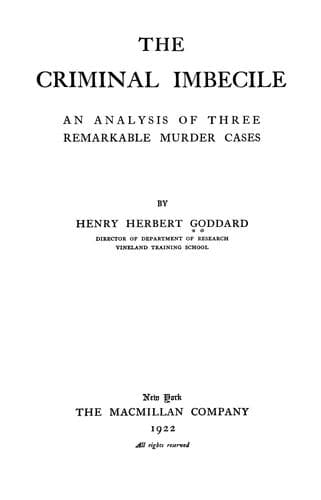
The Criminal Imbecile: An Analysis of Three Remarkable Murder CasesGoddard, Henry Herbert
Science
The Criminal Imbecile: An Analysis of Three Remarkable Murder Cases
Goddard, Henry Herbert
Crime -- Case studies; Murder -- Case studies; Offenders with mental disabilities -- Case studies
If we take the latter view, the question still remains, What shall be done
with these criminal imbeciles? The alternative to capital punishment is
incarceration for life. Here at least we find a distinction between these
persons and the normal intelligent wrongdoers. Of all persons in the
world, the criminal imbecile should be placed in custody under conditions
that will forever make it impossible for him to repeat his offense. The
man who commits murder in a fit of insanity may recover from his insanity
and be a useful citizen for the rest of his life. The man who commits
murder under a strong impulse of anger or in calm meditation as the result
of perverted reasoning may recover normal reasoning and be a useful
citizen. This is not true of the imbecile. He will never recover; he will
never have more mind than he has now; he will never be free from the
danger of following the suggestion of some wicked person or of yielding to
his own inborn and uncontrolled impulses. It will never be safe for him to
be at large. This is so obvious that it is highly probable that the
imbecile once committed to life custody would never be released, and even
that there would never be any attempt at such release. When these facts
are understood, the public will undoubtedly be satisfied to have such
persons imprisoned for life or committed to an institution for mental
defectives, where they will be constantly guarded and prevented from doing
injury.
This was well brought out in the case of at least two of the persons
described in this book. In the case of Jean Gianini, the lawyer made
emphatically plain that there was no desire on the part of the defense to
procure the complete liberty of the defendant. John F. McIntyre, the
counsel, stated clearly to the jury that he had no desire except to save
the boy from the electric chair, a punishment which he considered unjust.
He even went so far as to state that if at any time in the future efforts
should be made to secure the release of this defendant from any
institution to which he might be committed, he himself would make as
strenuous an effort to have the boy kept in custody as he was now making
to save him from the electric chair. Apparently this made a deep
impression upon the jury and went a long way toward helping them to return
the verdict that they did. On the other hand, in the case of Roland
Pennington this point was not made so clear, and the jury and the
prosecution did not realize that the defense only wished to save the boy
from execution and would be quite content with a verdict that would
result in his being incarcerated for life. An institution for
feeble-minded would seem at first glance to be the logical place to which
such a person should be committed. But no one need seriously object to
commitment to a penitentiary or a state prison. Perhaps, in view of the
fact that an imbecile has committed crime, that he has, as one may say,
Public-domain text, read in full here on John Shaqi.
Reviews
Reviews
No reviews yet
Be the first to share your thoughts on this work.
Elsewhere in the archive
Join the Discussion
Join the discussion
Sign in to leave a comment or review.
Sign InorCreate an account