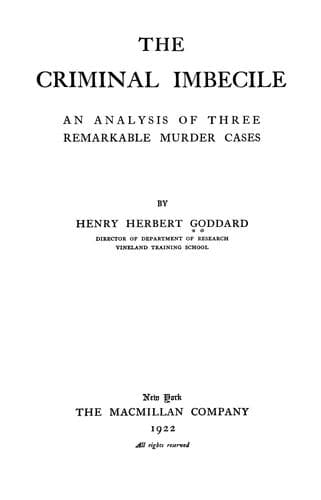
The Criminal Imbecile: An Analysis of Three Remarkable Murder CasesGoddard, Henry Herbert
Science
The Criminal Imbecile: An Analysis of Three Remarkable Murder Cases
Goddard, Henry Herbert
Crime -- Case studies; Murder -- Case studies; Offenders with mental disabilities -- Case studies
Assuming that on the 25th day of March, 1914, Mrs. Ethel Beecher and the
deceased Lida Beecher met the defendant at the Post Office in Poland, and
the defendant asked the deceased when she was coming to see his father,
and that she replied that she did not know, and the defendant said,
speaking impatiently, "Aw, I don't believe that you intend to come at all;
you will wait until the summer time and go home and then it will be too
late." That they spoke about school, and the deceased said to the
defendant that it would be better for him to wait until the beginning of
another term because he would be behind the other pupils in his work; that
on another occasion, on about the middle of February, 1914, the defendant
came on an errand to get yeast to the place where the deceased and Mrs.
Beecher were boarding and the defendant then said to them that he wanted
to get away from Poland, and would rather be in New York in the Great
White Way; that he thought he would like to act in moving pictures as he
did not like his home and he hated his father, and would not care to be a
"sod-buster"; that the deceased asked him whether he would like to return
to school, and he said that he would, but that his father would not let
him; that he never stole but once in his life and that was twenty-five
cents from a lady in New York, and she had given him twenty-five cents to
buy some candy and he bought the candy and ate it himself. On the same
visit the defendant asked Mrs. Ethel Beecher if there was a state prison
in Rochester, and she told him no; he wanted to know if there was not some
sort of a reform school there. She said that there used to be, but that
the reform school had removed to Industry, and he asked what the reform
school was like at Industry and she told him that the boys lived in
cottages under the care of a matron, a man and wife generally, and that
was as much as she knew about it. The defendant said he would like to be
there and asked her about the state prison at Auburn and different
prisons, what the sentence was and whether they had an electric chair or
whether they hung. The defendant told them that they worked awfully hard
at Sing Sing. The defendant also stated on that occasion that his father
used to thrash him for stealing apples that other men put him up to
stealing.
Public-domain text, read in full here on John Shaqi.
Reviews
Reviews
No reviews yet
Be the first to share your thoughts on this work.
Elsewhere in the archive
Join the Discussion
Join the discussion
Sign in to leave a comment or review.
Sign InorCreate an account