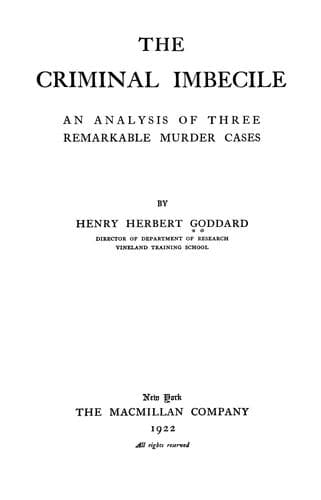
The Criminal Imbecile: An Analysis of Three Remarkable Murder CasesGoddard, Henry Herbert
Science
The Criminal Imbecile: An Analysis of Three Remarkable Murder Cases
Goddard, Henry Herbert
Crime -- Case studies; Murder -- Case studies; Offenders with mental disabilities -- Case studies
Assume that he had frequently been detected in telling lies, that he had
spoken of hatred of his father, that he manifested no affection towards
him, referring to his father as "Old Man" and "Him." That on the morning
of the 28th when he was being brought back to Poland by Newman, Newman
stated to him, "You have got something beside skipping out now staring you
in the face," to which he replied, "They can't give me but ten years"; he
used no words, when informed it might be a long time, that expressed fear
or fright; and when he was informed that he had murder staring him in the
face, he acted no different than ordinary.
That less than a year before the birth of Charles, the first child, the
defendant's mother suffered from an attack of diphtheria, for which she
was treated by Dr. Quinlan.
Further assume that in the summer of 1910, at Morehouseville, while
quarreling with a little boy named Arthur Jones, the defendant said he
would go up to his father's room and get his hunting knife and kill him.
That while the defendant was at St. Vincent's Industrial School for
juvenile delinquency, at work in the laundry, he told Mr. Minor that if
his father didn't get him out in February, he would burn his father's
buildings when he got out.
Now, doctor, assuming all these facts to have been proven in this case,
from your experience in the treatment of and knowledge of imbeciles and
idiots, from your skill and expert knowledge, can you express an opinion
concerning the mental condition of Jean Gianini at the time of the killing
of Lida Beecher, on the 27th day of March, 1914?
By Mr. Thomas: If the Court please, I object to the question as improper
in form and that it concludes with assuming all these facts to have been
proven in this case, and that it is not an inquiry which can be properly
permitted to be put to the witness here. That, in addition, it does not
correctly state the evidence, and that especially this part of the
question is improper--"That she showed no grief, and her general condition
was such as he described at the time he was treating her," referring to
Dr. Weeks, and further it assumes incorrectly the time that the defendant
encountered Miss Beecher, near the Post Office on the 27th day of March,
1914, which is stated here to be about a quarter after seven.
By Mr. Hirsch: What time do you say it was, Mr. Thomas?
Public-domain text, read in full here on John Shaqi.
Reviews
Reviews
No reviews yet
Be the first to share your thoughts on this work.
Elsewhere in the archive
Join the Discussion
Join the discussion
Sign in to leave a comment or review.
Sign InorCreate an account