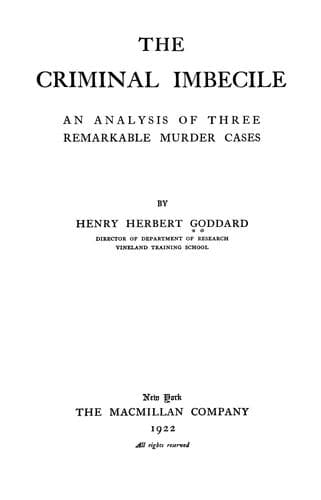
The Criminal Imbecile: An Analysis of Three Remarkable Murder CasesGoddard, Henry Herbert
Science
The Criminal Imbecile: An Analysis of Three Remarkable Murder Cases
Goddard, Henry Herbert
Crime -- Case studies; Murder -- Case studies; Offenders with mental disabilities -- Case studies
_Q._ I asked you what was your opinion concerning his mental condition.
_A._ That he is an imbecile.
_Q._ Now, Doctor, assuming that all the acts recited in the hypothetical
question to have been established by evidence, to be true, in conjunction
with the physical and mental examination made by you in the County Jail on
the 17th day of May this year,--from your experience and your knowledge of
imbeciles and idiots, in your opinion was Jean Gianini at the time of the
killing of Lida Beecher in such a mental condition as to know the nature
and quality of the act he was doing or that the act was wrong?
By Mr. Thomas: I object to it as improper in form and copulative.
Objection overruled.
_Q._ Your opinion, Doctor?
_A._ He was not in such condition.
APPENDIX B
GIANINI CASE
HYPOTHETICAL QUESTION PROPOUNDED BY THE PROSECUTION
_Q._ Doctor, kindly assume that the defendant had been a pupil taught by
Lida Beecher in the public school at Poland and harbored against her a
desire for revenge because she had punished him; that he stated to people
of his acquaintance that he would get even with her; that on Tuesday,
March 24th, 1914, he stated to a man with whom he was working that if he
had a revolver he would shoot her; that several days previously he had
this wrench, Ex. 45, in his possession and stated to a man who asked him
what he was going to do with it, that he had use for it; that he met Miss
Beecher, who was a young lady about twenty years old, five feet three
inches in height, weighing about 126 pounds, wearing upon the head this
cap, Ex. 26, and as an outer garment, this raincoat, Ex. 29 (showing to
witness), Wednesday, March 25th, 1914, about seven P.M. in the Post
Office at Poland, Post Office in the village of Poland, the location of
which is indicated on this map, Ex. 1, to which I now call your attention
(indicating); walked with her and Miss Clark, a teacher, from the Post
Office along Cold Brook Street to a point on the southerly side of the
street opposite the residence of James D. Countryman, the location of
which is also shown on the map at a point to which I now call your
attention (indicating), and that during that walk the defendant asked Miss
Beecher when she was coming up to see his father, and upon receiving the
answer that she did not know, said, "Aw, I don't believe you intend to
come at all; you will wait until summer time and go home and then it will
be too late"; that on the following evening, Thursday, he again met Miss
Beecher at or near the Post Office and asked her to go up to his house and
see his folks about going to school and she replied that she could not
that night, that she was going to prayer meeting, that she would go the
next night; that on the following day, Friday, he provided himself with
the knife, Ex. 48, for the occasion, and with the intention of killing
her, sharpened it for that purpose; that he met Miss Beecher about seven
P.M.
Public-domain text, read in full here on John Shaqi.
Reviews
Reviews
No reviews yet
Be the first to share your thoughts on this work.
Elsewhere in the archive
Join the Discussion
Join the discussion
Sign in to leave a comment or review.
Sign InorCreate an account