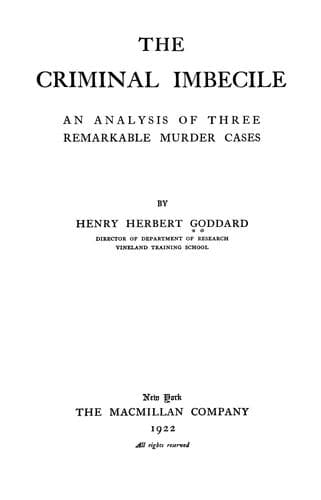
The Criminal Imbecile: An Analysis of Three Remarkable Murder CasesGoddard, Henry Herbert
Science
The Criminal Imbecile: An Analysis of Three Remarkable Murder Cases
Goddard, Henry Herbert
Crime -- Case studies; Murder -- Case studies; Offenders with mental disabilities -- Case studies
(indicating), to return some books of samples of wall paper, and to give
Mr. or Mrs. Owens a one-dollar bill and a soap order, to which it was
pinned; that he ran down the street, threw the books on to the veranda
floor near the kitchen door, ran down Cold Brook Street to South Main
Street, and tried to get the freight train which passed south on the M. &
M. railroad; that he ran back to his father's house and arrived there a
little after eight, took off his shoes, put on his slippers, read the
newspaper a little while, and went to bed; that he arose about six o'clock
the next morning; left his father's house, went to Sam Hutchinson's, by
whom he was employed, and whose residence is also shown on this Ex. 1, at
the location to which I now call your attention (indicating), went to the
barn, assisted in doing the chores, went in to breakfast, said nothing,
left there the coat, Ex. 41, which was then substantially in the same
condition as it is now, and to its condition, especially on the back, I
call your attention, and this being the coat which he wore the evening
before, which I now hand to you and call your attention to (indicating)
the condition of, put on another coat, and started down the railroad
track towards Herkimer, which is on the line of the New York Central and
Hudson River railroad, and some fourteen miles from Poland, intending then
to go away from Poland; that he was apprehended at Newport, a place
distant about four miles from Poland and between there and Herkimer, and
brought back in a cutter by Mr. Newman, whom he had known for several
years; that on the drive from Newport to Poland Newman asked him if he had
heard what happened at Poland, and defendant replied he hadn't; when asked
if he had seen anything of Miss Beecher the night before, said he had not;
when asked by Newman if he had heard that Miss Beecher was murdered or
killed, defendant said, "No," and on Newman's saying, "They are looking
for you for it," defendant said, "They can't give me but ten years, can
they?"; that as they drove into the village of Poland and turned from
South Main Street into Cold Brook Street, near the Post Office, there were
some rigs coming down the hill, and defendant said, "They are coming off
the hill with her now"; that in the afternoon of the same day he
voluntarily made, signed, and swore to the following statement with
reference to the matter.[3]
State, Doctor, basing your reply upon the hypothesis stated in the
question, whether or not, in your opinion, the defendant, at the time he
struck Miss Beecher with the wrench, understood that he had no right to do
it?
Mr. McIntyre: Don't answer. We object to the question in that it only
recites the revolting details of the alleged crime and that when the
question was being propounded to the witness upon the stand, counsel for
the State exhibited the knife, the wrench, the coat, the hat, and other
things in evidence in rather a dramatic way before the jury.
Public-domain text, read in full here on John Shaqi.
Reviews
Reviews
No reviews yet
Be the first to share your thoughts on this work.
Elsewhere in the archive
Join the Discussion
Join the discussion
Sign in to leave a comment or review.
Sign InorCreate an account