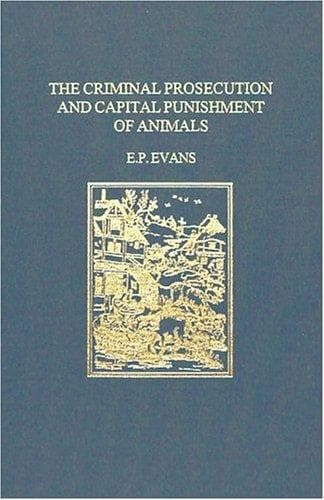
The Criminal Prosecution and Capital Punishment of AnimalsEvans, E. P. (Edward Payson)
History
The Criminal Prosecution and Capital Punishment of Animals
Evans, E. P. (Edward Payson)
Animals -- Law and legislation -- History; Animals, Prosecution and punishment of -- History; Trials -- Europe
According to an old Anglo-Saxon law, abolished by King Canute, in case
stolen property was found in the house of a thief, his wife and family,
even to the infant in the cradle, though it had never taken food (_peâh
hit nafre metes ne âbîte_), were punished as partakers of his guilt. The
_Schwabenspiegel_, the oldest digest of South German law, treated as
accessaries all the domestic animals found in a house, in which a crime of
violence had been committed, and punished them with death. [“Man soll
allez daz tötden daz in den huze ist gevonden: leuten und vie, ros und
rinder, hunde und katzen, ganzen und hundre.” § 290.]
Cicero approved of such penalties for political crimes as “severe but wise
enactments, since the father is thereby bound to the interests of the
state by the strongest of ties, namely, love for his children.” Roman law
under the empire punished treason with death and then added: “As to the
sons of traitors, they ought to suffer the same penalty as their parents,
since it is highly probable that they will sometime be guilty of the same
crime themselves; nevertheless, as a special act of clemency, we grant
them their lives, but, at the same time, declare them to be incapable of
inheriting anything from father or mother or of receiving any gift or
bequest in consequence of any devise or testament of kinsmen or friends.
Branded with hereditary infamy and excluded from all hope of honour or of
property, may they suffer the torture of disgrace and poverty until they
shall look upon life as a curse and long for death as a kind release.”
This atrocious edict of the emperors Arcadius and Honorius has its
counterpart in the still more radical code of Pachacutez, the Justinian of
the ancient Peruvians, which punished adultery with the wife of an Inca by
putting to death not only the adulteress and her seducer, but also the
children, slaves and kindred of the culprits, as well as all the
inhabitants of the city in which the crime was committed, while the city
itself was to be razed and the site covered with stones.
The principle enunciated by Cicero has also been accepted by modern
legislators as applicable to high treason. Thus, when Tschech, the
burgomaster of Storkow, attempted to take the life of Frederic William of
Prussia, July 26, 1844, he was tried and executed Dec. 14 of the same
year. On the day after his execution his only daughter, Elizabeth, was
arrested, and to her inquiry by what right she had been deprived of her
freedom, the authorities replied that, “according to Prussian law the
children of a person convicted of high treason and all the members of his
family, especially if they seemed to be dangerous and to share the
opinions of their father, can be imprisoned for life or banished from the
country.” The young lady was then exiled to Westphalia, and there placed
in the custody of an extremely austere parson, until she finally escaped
to France, and afterwards to Switzerland, where she spent the rest of her
days.
Public-domain text, read in full here on John Shaqi.
Reviews
Reviews
No reviews yet
Be the first to share your thoughts on this work.
Elsewhere in the archive
Join the Discussion
Join the discussion
Sign in to leave a comment or review.
Sign InorCreate an account