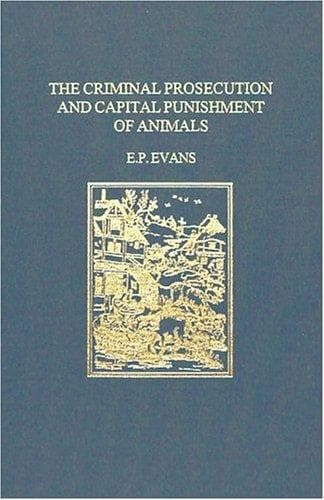
The Criminal Prosecution and Capital Punishment of AnimalsEvans, E. P. (Edward Payson)
History
The Criminal Prosecution and Capital Punishment of Animals
Evans, E. P. (Edward Payson)
Animals -- Law and legislation -- History; Animals, Prosecution and punishment of -- History; Trials -- Europe
The horrible mutilations to which criminals were formerly subjected,
originated in an endeavour to administer strictly even-handed justice.
What could be fairer or more fit than to punish perjury by cutting off the
two fingers which the perjurer had held up in taking the violated oath? It
was a popular belief that the fingers of an undetected perjurer would grow
out of the grave after death, seeking retributive amputation, as a plant
seeks the light, and that his ghost would never rest until this penalty
had been inflicted. (See Heinrich Roch: _Schles. Chron._, p. 267, where a
case of this kind is recorded.) The Carolina (_constitutio criminalis
Carolina_), although in many respects an advance on mediæval penal
legislation, doomed incendiaries to be burned alive; and an old law, cited
by Döpler (_Theat. Poen._, II. 271), condemned a man who had dug up and
removed a boundary stone to be buried in the earth up to his neck and to
have his head plowed off with a new plow, thus symbolizing in his own
person the grave offence which he had committed. Ivan Basilovitch, a
Muscovite prince, ordered that an ambassador, who did not uncover in his
presence, should have his hat nailed to his head; and it is a feeble
survival of the same idea of proper punishment that makes the American
farmer nail the dead hawk to his barn-door, just as in former times it was
customary to crucify highway robbers at cross-roads.
According to an old Roman law ascribed to Numa Pompilius, the oxen which
plowed up a boundary stone, as well as their driver, were sacrificed to
Jupiter Terminus. In the early development of agriculture, and the
transition from communal to personal property in land, this severe
enactment was deemed necessary to the protection of the “sacra saxa,” by
which the boundary lines of the fields were defined. Only by making the
violation of enclosed ground a sacrilege was it possible to prevent
encroachments upon it, so strong was the lingering prejudice against
individual possessions of this kind running in the blood of a people
descended from nomadic tribes of herdsmen, who regarded sedentary
communities engaged in tilling the soil as their direst foes. The lawgiver
knew very well that the oxen were involuntary agents, and that the plowman
alone was culpable; but when a religious atonement is to be made and an
angry god appeased, moral distinctions determining degrees of
responsibility are uniformly ignored, and the innocent are doomed to
suffer with the guilty. The oxen were tainted by the performance of an
act, in which the exercise of their will was not involved, and must
therefore be consigned to the offended deity. The same is true of the
plowman, who did not escape immolation even when the _motio termini_ or
displacement of the boundary stone occurred unintentionally.
Public-domain text, read in full here on John Shaqi.
Reviews
Reviews
No reviews yet
Be the first to share your thoughts on this work.
Elsewhere in the archive
Join the Discussion
Join the discussion
Sign in to leave a comment or review.
Sign InorCreate an account