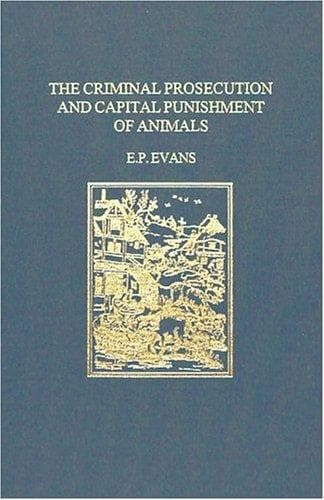
The Criminal Prosecution and Capital Punishment of AnimalsEvans, E. P. (Edward Payson)
History
The Criminal Prosecution and Capital Punishment of Animals
Evans, E. P. (Edward Payson)
Animals -- Law and legislation -- History; Animals, Prosecution and punishment of -- History; Trials -- Europe
The same process of reasoning would lead to the admission of
quasi-vitiations of mind and quasi-irresistible forces as grounds of
exculpation. Thus one might go on analyzing and refining away human
responsibility, and reducing all crime to resultants of mental
derangement, until every malefactor would come to be looked upon, not as a
culprit to be delivered over to the sharp stroke of the headsman or the
safe custody of the jailer, but as an unfortunate victim of morbid states
and uncontrollable impulses, to be consigned to the sympathetic care of
the psychiater.
Italian anthropologists and jurisprudents have been foremost and gone
farthest, both theoretically and practically, in this reaction from
mediæval conceptions of crime and its proper punishment. This violent
recoil from extreme cruelty to excessive commiseration is due, in a great
measure, to the Italian temperament, to a peculiar gentleness and
impressionableness of character, which, combined with an instinctive
aversion to whatever shocks the senses and mars the pleasure of the
moment, are apt to degenerate into shallow sentimentality and sickly
sensibility, thereby enfeebling and perverting the moral sense and
distorting all ideas of right and justice. To minds thus constituted the
cool and deliberate condemnation of a human being to the gallows is an
atrocity, in comparison with which a fatal stab in the heat of passion or
under strong provocation seems a light and venial transgression. This
maudlin sympathy with the guilty living man, who is in danger of suffering
for his crime, to the entire forgetfulness of the innocent dead man, the
victim of his anger or cupidity, pervades all classes of society, and has
stimulated the ingenuity of lawyers and legislators to discover mitigating
moments and extenuating circumstances and other means of loosening and
enlarging the intricate meshes of the penal code so as to permit the
culprit to escape. To this end they eagerly seized upon the doctrine of
evolution and endeavoured to seek the origin of crime in hereditary
propensities, atavistic recurrences, physical degeneracies and other
organic fatalities, for which no one can be held personally responsible,
and constructed upon the basis of the most recent scientific researches a
penological system giving free scope and full gratification to this
pitying and palliating disposition.
Public-domain text, read in full here on John Shaqi.
Reviews
Reviews
No reviews yet
Be the first to share your thoughts on this work.
Elsewhere in the archive
Join the Discussion
Join the discussion
Sign in to leave a comment or review.
Sign InorCreate an account