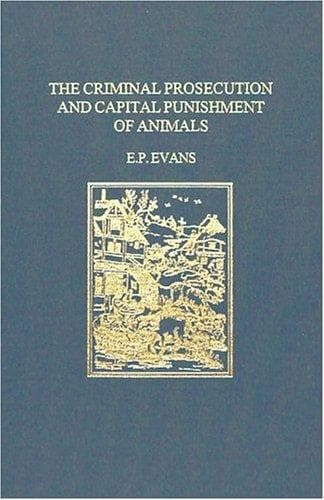
The Criminal Prosecution and Capital Punishment of AnimalsEvans, E. P. (Edward Payson)
History
The Criminal Prosecution and Capital Punishment of Animals
Evans, E. P. (Edward Payson)
Animals -- Law and legislation -- History; Animals, Prosecution and punishment of -- History; Trials -- Europe
Mediæval penal justice sought to inflict the greatest possible amount of
suffering on the offender and showed a diabolical fertility of invention
in devising new methods of torture even for the pettiest trespasses. The
monuments of this barbarity may now be seen in European museums in the
form of racks, thumbkins, interlarded hares, Pomeranian bonnets, Spanish
boots, scavenger’s daughters, iron virgins and similar engines of cruelty.
Until quite recently an iron virgin, with its interior full of long and
sharp spikes, was exhibited in a subterranean passage at Nuremberg, on the
very spot where it is supposed to have once performed its horrible
functions; and in Munich this inhuman instrument of punishment was in
actual use as late as the beginning of the nineteenth century. The
criminal code of Maria Theresa, published in 1769, contained forty-five
large copperplate engravings, illustrating the various modes of torture
prescribed in the text for the purpose of extorting confession and
evidently designed to serve as object lessons for the instruction of the
tormentor and the intimidation of the accused. That Prussia was the first
country in Germany to abolish judicial torture was due, not to the
progressive spirit of the nation or of its tribunals, but solely to the
superior enlightenment and energy of Frederic the Great, who effected this
reform arbitrarily and against the will of jurists and judges by
cabinet-orders issued in 1740 and 1745. Crimes which women are under
peculiar temptation to commit, were punished with extraordinary severity.
Thus the infanticide was buried alive, a small tube communicating with the
outer air being placed in her mouth in order to prolong her life and her
agony. A case of this kind is recorded in the proceedings of the
“Malefiz-Gericht” or criminal court of Ensisheim in Alsatia under the date
of February 3, 1570. In 1401, an apprentice, who stole from his master
five pfennigs (then as now the smallest coin of Germany and worth about
the fifth of a cent), was condemned to have both his ears cut off.
Incredible barbarities of this kind were practised by some of the best and
noblest men of that age. Thus Cardinal Carlo Borromeo, who was pre-eminent
among his contemporaries for the purity of his life and the benevolence of
his character, did not hesitate to condemn Fra Tommaso di Mileto, a
Franciscan monk, to be walled up alive, because he entertained heretical
notions concerning the sinfulness of eating meat on Friday, and expressed
doubts touching the worship of images, indulgences, the supreme and
infallible authority of the pope, and the real presence in the eucharist.
This cruel sentence, a striking illustration of the words of Lucretius,
“Tantum religio potuit suadere malorum,”
Public-domain text, read in full here on John Shaqi.
Reviews
Reviews
No reviews yet
Be the first to share your thoughts on this work.
Elsewhere in the archive
Join the Discussion
Join the discussion
Sign in to leave a comment or review.
Sign InorCreate an account