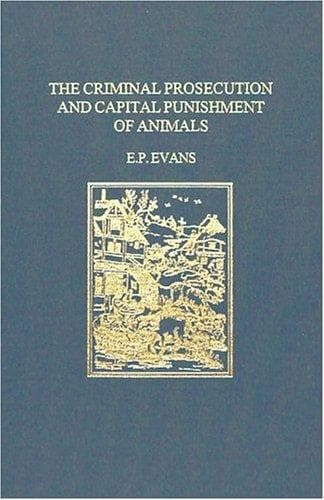
The Criminal Prosecution and Capital Punishment of AnimalsEvans, E. P. (Edward Payson)
History
The Criminal Prosecution and Capital Punishment of Animals
Evans, E. P. (Edward Payson)
Animals -- Law and legislation -- History; Animals, Prosecution and punishment of -- History; Trials -- Europe
the prosecution, which had been awaited with intense and anxious interest
by the people, were received with great joy, and the Bernese government
ordered a full report of the proceedings to be made. The ecclesiastical
anathema, however, proved to be _brutum fulmen_; nothing more came of it,
says Schilling, “owing to our sins.” Another chronicler adds that God
permitted the inger to remain as a plague and a punishment until the
people repented of their wickedness and gave evidence of their love and
gratitude to Him, namely, by giving to the Church tithes of what the
insects had not destroyed.
The Swiss priest in his malediction declares that the inger were not in
Noah’s ark and even denies that they are animals properly speaking,
stigmatizing them as living corruption, products of spontaneous generation
perhaps, or more probably creations of the devil. This position was
assumed in order to escape the gross impropriety and glaring incongruity
of having the Church of God curse the creatures which God had made and
pronounced very good, and afterwards took pains to preserve from
destruction by the deluge. This difficulty, always a serious one, was, as
we have seen, one of the chief points urged by the counsel for the defence
in favour of his clients.
Malleolus gives the following formula for banning serpents and expelling
them from human habitations, inculcating incidentally the iniquity of
perjury and judicial injustice: “By virtue of this ban and conjuration I
command you to depart from this house and cause it to be as hateful and
intolerable to you, as the man, who knowingly bears false witness or
pronounces an unjust sentence, is to God.” Sometimes the exorcism was in
the form of a prayer, as, for example, in that used for the purgation and
disinfection of springs and water-courses: “O Lord Jesus, thou who didst
bless the river Jordan and wast baptized in it and hast purified and
cleansed it to the end that it might be a healing element for the
redemption from sin, bless, sanctify and purify this water, so that there
may be left in it nothing noxious, nothing pestiferous or contagious,
nothing pernicious, but that everything in it may be pure and immaculate,
in order that we may use whatever is created in it for our welfare and to
thy glory, through our Lord Jesus Christ. Amen.”
Public-domain text, read in full here on John Shaqi.
Reviews
Reviews
No reviews yet
Be the first to share your thoughts on this work.
Elsewhere in the archive
Join the Discussion
Join the discussion
Sign in to leave a comment or review.
Sign InorCreate an account