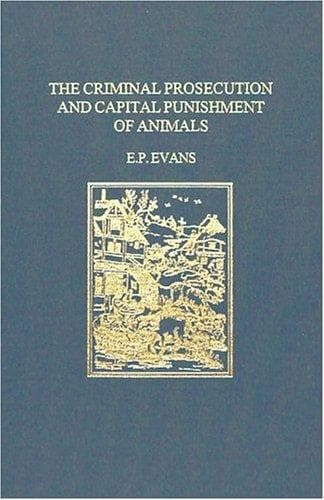
The Criminal Prosecution and Capital Punishment of AnimalsEvans, E. P. (Edward Payson)
History
The Criminal Prosecution and Capital Punishment of Animals
Evans, E. P. (Edward Payson)
Animals -- Law and legislation -- History; Animals, Prosecution and punishment of -- History; Trials -- Europe
Brutes and human criminals were confined in the same prison and subjected
to the same treatment. Thus “Toustain Pincheon, keeper of the prisons of
our lord the king in the town of Pont de Larche,” acknowledges the
receipt, “through the hand of the honourable and wise man, Jehan Monnet,
sheriff (_vicomte_) of the said town, of nineteen sous six deniers
tournois for having found the king’s bread for the prisoners detained, by
reason of crime, in the said prison.” The jailer gives the names of the
persons in custody, and concludes the list with “Item, one pig, conducted
into the said prison and kept there from the 24th of June, 1408,
inclusive, till the 17th of the following July,” when it was hanged “for
the crime of having murdered and killed a little child” (_pource que
icellui porc avoit muldry et tue ung pettit enfant_). For the pig’s board
the jailer charged two deniers tournois a day, the same as for boarding a
man, thus placing the porker, even in respect to its maintenance, on a
footing of perfect equality with the human prisoners. He also puts into
the account “ten deniers tournois for a rope, found and furnished for the
purpose of tying the said pig that it might not escape.” The correctness
of the charges is certified to by “Jean Gaulvant, sworn tabellion of our
lord the king in the viscounty of Pont de Larche.” (_Vide_ Appendix J.)
Again in 1474, the official of the Bishop of Lausanne sentenced a pig to
be hanged “until death ensueth,” for having devoured an infant in its
cradle in the vicinity of Oron, and to remain suspended from the gallows
for a certain length of time as a warning to wrong-doers. It is also
expressly stated that, in 1585, the body of a pig, which had been executed
for the murder of a child at Saint-Omer, at the hostelry of Mortier d’Or,
was left hanging “for a long space” on a gibbet in a field near the
highway. (Derheims: _Histoire de Saint-Omer_, p. 327.) A little later a
similar spectacle met the eyes of Guy Pape, as he was going to
Châlons-sur-Marne in Champagne, to pay homage to King Henry IV. In his own
words: _dum ibam ad civitatem Cathalani in Campania ad Regem tunc ibi
existentem, vidi quemdam porcum, in furcis suspensum, qui dicebatur
occidisse quemdam puerum_. (Quaestio CCXXXVIII: _De poena bruti
delinquentis_. Lugduni, MDCX.)
Public-domain text, read in full here on John Shaqi.
Reviews
Reviews
No reviews yet
Be the first to share your thoughts on this work.
Elsewhere in the archive
Join the Discussion
Join the discussion
Sign in to leave a comment or review.
Sign InorCreate an account