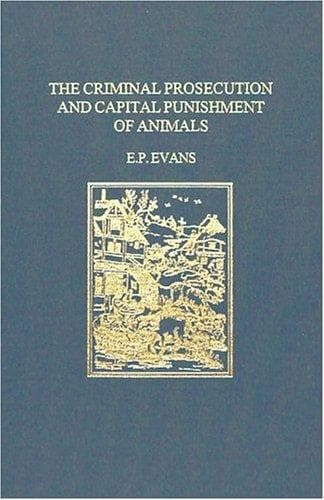
The Criminal Prosecution and Capital Punishment of AnimalsEvans, E. P. (Edward Payson)
History
The Criminal Prosecution and Capital Punishment of Animals
Evans, E. P. (Edward Payson)
Animals -- Law and legislation -- History; Animals, Prosecution and punishment of -- History; Trials -- Europe
On the 14th of June, 1494, a young pig was arrested for having “strangled
and defaced a young child in its cradle, the son of Jehan Lenfant, a
cowherd on the fee-farm of Clermont, and of Gillon his wife,” and
proceeded against “as justice and reason would desire and require.”
Several witnesses were examined, who testified “on their oath and
conscience” that “on the morning of Easter Day, as the father was guarding
cattle and his wife Gillon was absent in the village of Dizy, the infant
being left alone in its cradle, the said pig entered during the said time
the said house and disfigured and ate the face and neck of the said
child, which, in consequence of the bites and defacements inflicted by the
said pig, departed this life (_de ce siècle trépassa_).” The sentence
pronounced by the judge was as follows, “We, in detestation and horror of
the said crime, and to the end that an example may be made and justice
maintained, have said, judged, sentenced, pronounced and appointed, that
the said porker, now detained as a prisoner and confined in the said
abbey, shall be by the master of high works hanged and strangled on a
gibbet of wood near and adjoinant to the gallows and high place of
execution belonging to the said monks, being contiguous to their fee-farm
of Avin.” The crime was committed “on the fee-farm of
Clermont-lez-Montcornet, appertaining in all matters of high, mean and
base justice to the monks of the order of Premonstrants,” and the
prosecution was conducted by “Jehan Levoisier, licenciate in law, the
grand mayor of the church and monastery of St. Martin de Laon of the order
of Premonstrants and the aldermen of the same place.” The plaintiffs were
the friars, who preferred charges against the pig and procured the
evidence necessary to its conviction. (_Vide_ Appendix O.)
In 1394, a pig was hanged at Mortaign for having sacrilegiously eaten a
consecrated wafer; and in a case of infanticide, it is expressly stated in
the plaintiff’s declaration that the pig killed the child and ate of its
flesh, “although it was Friday,” and this violation of the _jejunium
sextae_, prescribed by the Church, was urged by the prosecuting attorney
and accepted by the court as a serious aggravation of the porker’s
offence.
Public-domain text, read in full here on John Shaqi.
Reviews
Reviews
No reviews yet
Be the first to share your thoughts on this work.
Elsewhere in the archive
Join the Discussion
Join the discussion
Sign in to leave a comment or review.
Sign InorCreate an account