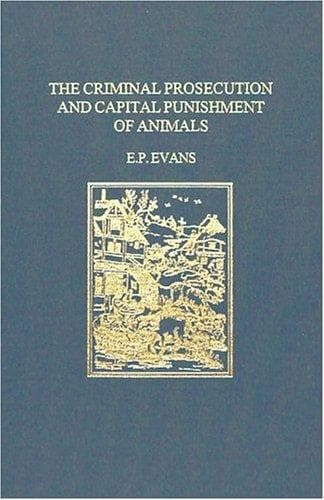
The Criminal Prosecution and Capital Punishment of AnimalsEvans, E. P. (Edward Payson)
History
The Criminal Prosecution and Capital Punishment of Animals
Evans, E. P. (Edward Payson)
Animals -- Law and legislation -- History; Animals, Prosecution and punishment of -- History; Trials -- Europe
In 1474, the magistrates of Bâle sentenced a cock to be burned at the
stake “for the heinous and unnatural crime of laying an egg.” The _auto da
fé_ was held on a height near the city called the Kohlenberg, with as
great solemnity as would have been observed in consigning a heretic to the
flames, and was witnessed by an immense crowd of townsmen and peasants.
The statement made by Gross in his _Kurze Basler Chronik_, that the
executioner on cutting open the cock found three more eggs in him, is of
course absurd; we have to do in this case not with a freak of nature, but
with the freak of an excited imagination tainted with superstition. Other
instances of this kind have been recorded, one in the Swiss Prättigau as
late as 1730, although in many cases the execution of the gallinaceous
malefactor was more summary and less ceremonious than at Bâle.
The _oeuf coquatri_ was supposed to be the product of a very old cock and
to furnish the most active ingredient of witch ointment. When hatched by a
serpent or a toad, or by the heat of the sun it brought forth a cockatrice
or basilisk, which would hide in the roof of the house and with its
baneful breath and “death-darting eye” destroy all the inmates. Many
naturalists believed this fable as late as the eighteenth century, and in
1710 the French savant Lapeyronie deemed this absurd notion worthy of
serious refutation, and read a paper, entitled “Observation sur les petits
oeufs de poule sans jaune, que l’on appelle vulgairement oeufs de Coq,”
before the Academy of Sciences in order to prove that cocks never lay and
that the small and yolkless eggs attributed to them owe their peculiar
shape and condition to a disease of the hen resulting in a hydropic
malformation of the oviduct. A farmer brought him several specimens of
this sort, somewhat larger than a pigeon’s egg, and assured him that they
had been laid by a cock in his own barnyard. On opening one of them, M.
Lapeyronie was surprised to find only a very slight trace of the yolk
resembling “a small serpent coiled.” He now began to suspect that the cock
might be an hermaphrodite, but on killing and dissecting it discovered
nothing in support of this theory, the internal organs being all perfectly
healthy and normal. But although the unfortunate chanticleer had fallen a
victim to the scientific investigation of a popular delusion, the eggs in
question continued to be produced, until the farmer by carefully watching
the fowls detected the hen that laid them. The dissection showed that the
pressure of a bladder of serous fluid against the oviduct had so
contracted it, that the egg in passing had the yolk squeezed out of it,
leaving merely a yellowish discoloration that looked like a worm. Another
peculiarity of this hen was that she crowed like “a hoarse cock” (_un coq
enroué_), only more violently; a phenomenon also a source of terror to the
superstitious, but ascribed by M. Lapeyronie to the same morbid state of
Public-domain text, read in full here on John Shaqi.
Reviews
Reviews
No reviews yet
Be the first to share your thoughts on this work.
Elsewhere in the archive
Join the Discussion
Join the discussion
Sign in to leave a comment or review.
Sign InorCreate an account