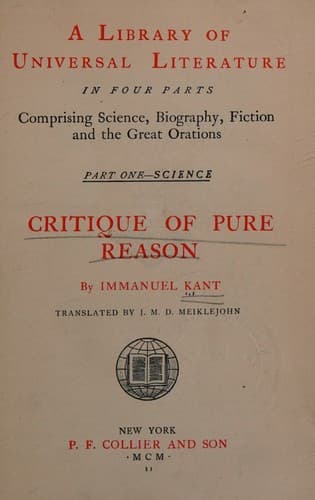
Causation; Knowledge, Theory of; Philosophy, German; Reason
But there is one thing in the above demonstration of which I could not
make abstraction, namely, that the manifold to be intuited must be
given previously to the synthesis of the understanding, and
independently of it. How this takes place remains here undetermined.
For if I cogitate an understanding which was itself intuitive (as, for
example, a divine understanding which should not represent given
objects, but by whose representation the objects themselves should be
given or produced), the categories would possess no significance in
relation to such a faculty of cognition. They are merely rules for an
understanding, whose whole power consists in thought, that is, in the
act of submitting the synthesis of the manifold which is presented to
it in intuition from a very different quarter, to the unity of
apperception; a faculty, therefore, which cognizes nothing per se, but
only connects and arranges the material of cognition, the intuition,
namely, which must be presented to it by means of the object. But to
show reasons for this peculiar character of our understandings, that it
produces unity of apperception à priori only by means of categories,
and a certain kind and number thereof, is as impossible as to explain
why we are endowed with precisely so many functions of judgement and no
more, or why time and space are the only forms of our intuition.
In Cognition, its Application to Objects of Experience is the only
legitimate use of the Category § 18
To think an object and to cognize an object are by no means the same
thing. In cognition there are two elements: firstly, the conception,
whereby an object is cogitated (the category); and, secondly, the
intuition, whereby the object is given. For supposing that to the
conception a corresponding intuition could not be given, it would still
be a thought as regards its form, but without any object, and no
cognition of anything would be possible by means of it, inasmuch as, so
far as I knew, there existed and could exist nothing to which my
thought could be applied. Now all intuition possible to us is sensuous;
consequently, our thought of an object by means of a pure conception of
the understanding, can become cognition for us only in so far as this
conception is applied to objects of the senses. Sensuous intuition is
either pure intuition (space and time) or empirical intuition—of that
which is immediately represented in space and time by means of
sensation as real. Through the determination of pure intuition we
obtain à priori cognitions of objects, as in mathematics, but only as
regards their form as phenomena; whether there can exist things which
must be intuited in this form is not thereby established. All
mathematical conceptions, therefore, are not per se cognition, except
in so far as we presuppose that there exist things which can only be
represented conformably to the form of our pure sensuous intuition. But
things in space and time are given only in so far as they are
Public-domain text, read in full here on John Shaqi.
Reviews
Reviews
No reviews yet
Be the first to share your thoughts on this work.
Elsewhere in the archive
Join the Discussion
Join the discussion
Sign in to leave a comment or review.
Sign InorCreate an account